In version 2602 of Simcenter STAR-CCM+, the highly anticipated tool Simcenter PhysicsAI was introduced into Design Manager as an Add-on. With this new Reduced Order Modelling (ROM) approach, CFD engineers are now able to configure AI models based on either historical results, obtained during say a previous design cycle, or set up a completely new Design Manager study with the purpose of training a much faster data-driven mathematical model. For the bigger picture, see how CFD and simulation feed a digital twin.
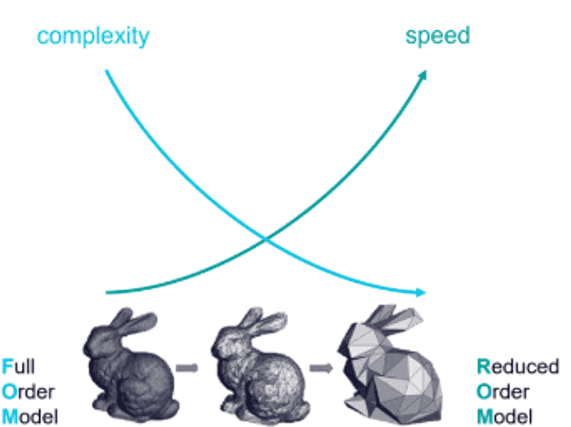
There are several reasons why this workflow can benefit your simulation work, but in essence, this new type of geometrical ROM enables rapid exploration of design variations in a flexible and efficient manner. At its core, the underlying technology of Simcenter PhysicsAI identifies the relationship between geometry and corresponding simulation results, such as flow fields and scalar quantities. By leveraging this capability, PhysicsAI can make predictions for previously unseen (novel) designs, which would otherwise be computationally expensive to evaluate using the direct approach. Additionally, this approach does not require the new designs to adhere to the same geometric parameterization used during training, meaning the workflow supports both parametric and non-parametric geometry.
To provide a clearer and more concrete example, consider the design of a rear spoiler for a car. A geometric ROM can be trained on simulation results generated from multiple design variants, where the spoiler shape is modified using a set of geometric parameters. Once the ROM has been trained and validated, it can be used to predict quantities such as the velocity flow field around the spoiler, the lift forces acting on the geometry, and the resulting drag.
These predictions can be obtained either by varying the same design parameters used in the training dataset or, more importantly, by introducing entirely new designs that are not constrained by those original parameters. This added flexibility enables a more exploratory and collaborative design process, where designers and simulation engineers can rapidly iterate and evaluate new concepts together within a significantly shorter timeframe. A design and simulation process that is typically far more time‑consuming.
The term “reduced” in Reduced Order Models reflects a defining aspect of this technology. A data-driven mathematical model of this type contains an inherit reduction in complexity, this is intentional. All reduced order models have the benefit of speed while sacrificing fidelity with the decrease of accuracy. There is always a trade-off between a ROM’s versatility, i.e. how many different types of studies a specific ROM can be used for, and the accuracy of the predictions, verses, the time spent on generating the necessary datasets, training the Geometric Deep Learning (GDL) model, and tuning hyper parameters. This being said, the leaps made in development within this area in recent years are significant, and large strides have been taken in making ROMs more proficient, requiring less training-data, and becoming more versatile in their end use.
My colleague Christoffer provides an introduction and demonstrates PhysicsAI’s workflow in this article: Simcenter Physics AI workflow, based on a Simcenter STAR-CCM+ study. Additionally, as you are likely aware of, there are many different types of Reduced Order Models. For those interested in exploring another ROM approach available within Design Manager, this article, although slightly dated, provides a practical example of Dynamic Neural Networks developed using Simcenter ROM: Time Dependent Neural Networks with Simcenter Amesim’s ROM Builder
For those of us accustomed to working through Simcenter STAR-CCM+, one large benefit of this new Add-on compared to the stand-alone version of Simcenter Physics AI, is the ease with which design studies can be set up and run. Model training and evaluation are also done through Design Manager, making it convenient to reference new .sim files, update old ones for further training, or when exploring geometry changes using for instance Intelligent Design Exploration.
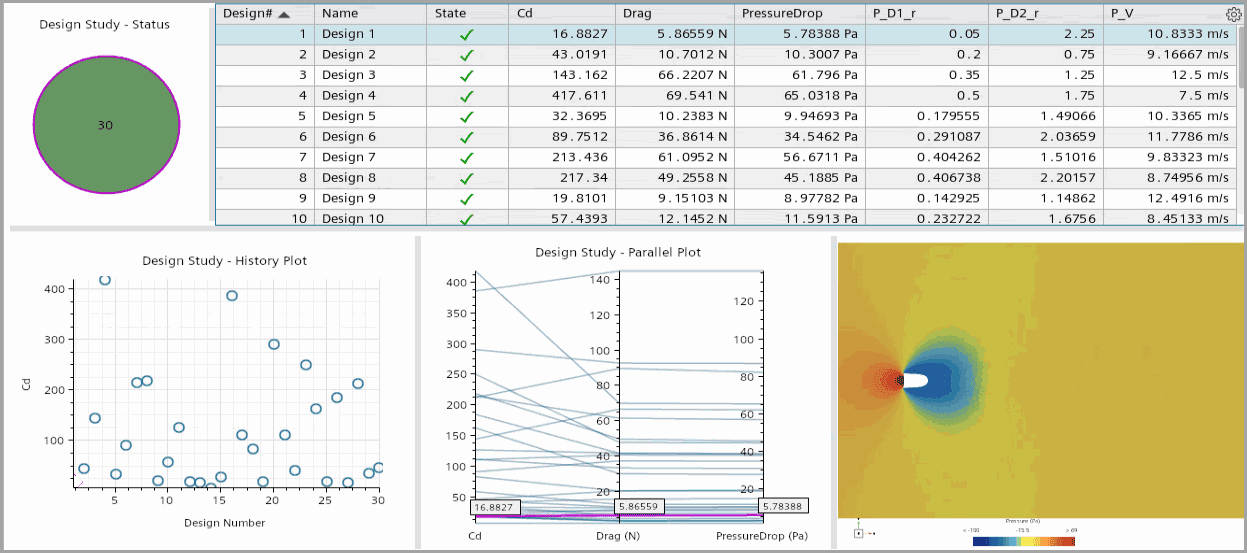
Above, the Adaptive Sampling study generating data for ROM training.
Now, lets have a look at the workflow and how things are configured inside Simcenter STAR-CCM+
To create a PhysicsAI ROM inside Simcenter STAR-CCM+, the add-on has to be installed. This add-on is found on Siemens Support Portal under downloads and then PhysicsAI Add-on 2510. This new tool requires and additional license in order to run.
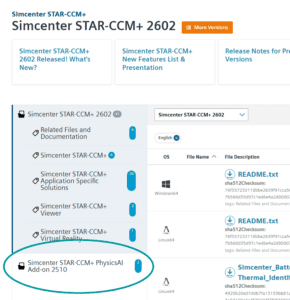
Once correctly added to the software, new functionality relating to Simcenter PhysicsAI will become available inside Design Manager.
Below the general workflow for creating a geometric ROM is given:
- Prepare your training data.
- Generate the Geometric Deep Learning (GDL) ROM. Either as a Surface ROM capturing surface fields, or a Volume ROM capturing volume fields.
- Use the trained ROM to investigate behavior resulting from a design change, or explore new designs using the ROM in combination with optimization.
To showcase this approach, the tutorial case found among Simcenter STAR-CCM+’s tutorials is borrowed as visual aid when explaining and discussing the different steps taken.
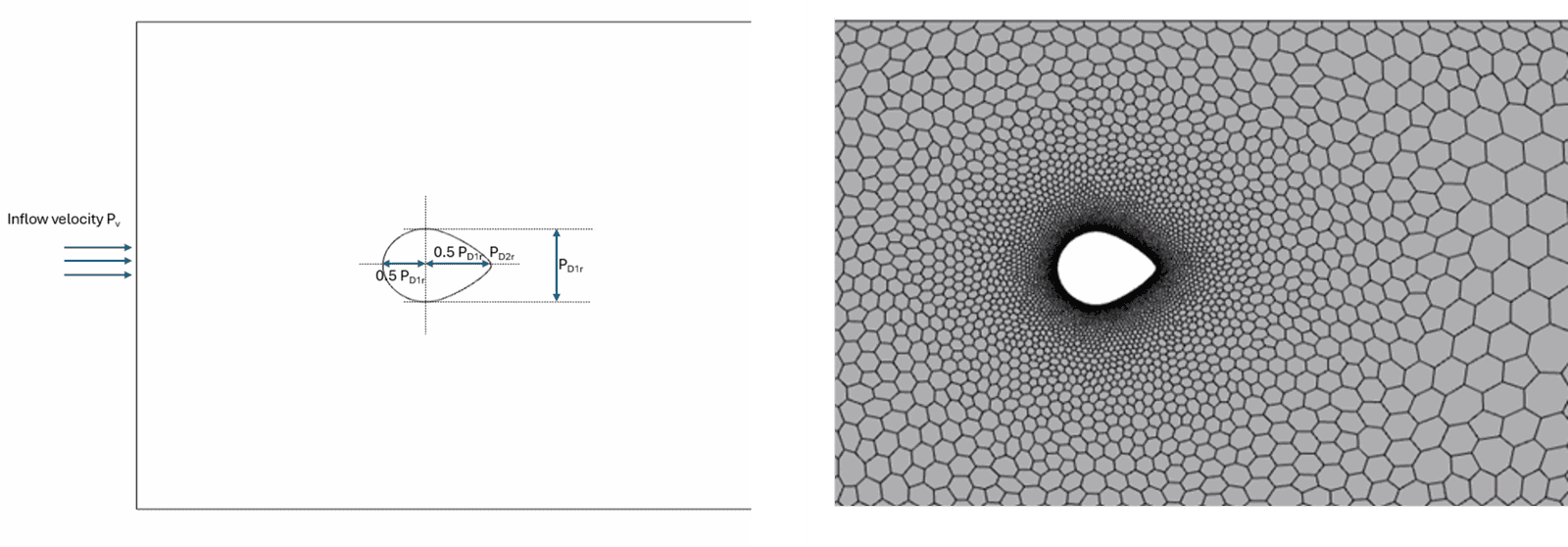
The tutorial case: Optimization of a parameterized aerodynamic shape to minimize drag.
The simulation case’s geometry is parameterized in 3D CAD and two design parameters have been made to global parameters along with the domain’s inlet velocity. A steady-state simulation approach is used to capture the drag force along the x-direction.
Once the case setup is completed in Simcenter STAR-CCM+’s main GUI, the remaining workflow is carried out within Design Manager. A new study is created, and the Adaptive Sampling study type is selected, where 30 different cases are executed. During these runs, the two geometric parameters and the inlet velocity are varied, with drag defined as the response of interest.
When configuring a study in Design Manager with the objective of generating new training data, it is also necessary to define a node called “AI ROM Datasets”. This node, available through the PhysicsAI add-on, allows users to specify which types of simulation data should be stored, such as surface data, volume data, and additional response quantities.
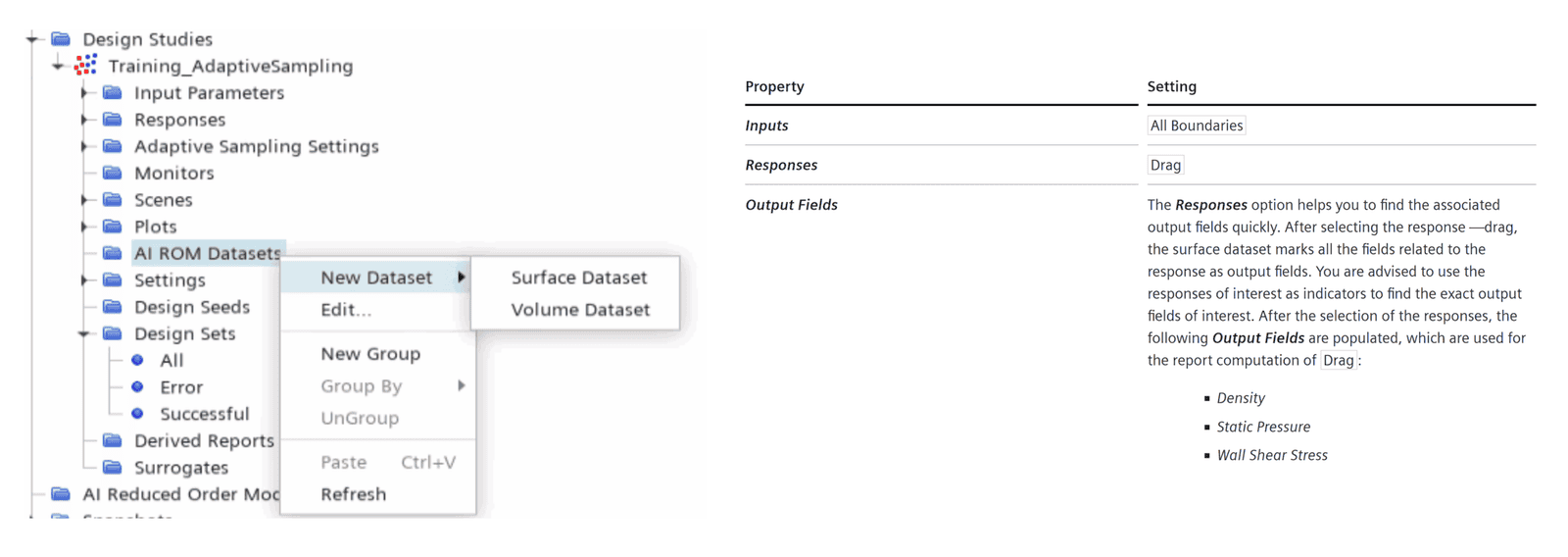
Design Manager exports the collected datasets to Simcenter PhysicsAI in the form of .json and .simh files, and Simcenter PhysicsAI trains the ROM and return the results to Design Manager through .simh files. Depending on the engineering problem at hand, Simcenter PhysicsAI can train three types of models for a Surface ROM or a Volume ROM.
- A field model, which provides a neural network approximation of one or more fields. The ROM can be used for estimating flow fields and response values derived from the fields. Reports with the property “Compatible with Solution Representation” enabled can be evaluated as derived response values.
- The response model, which provides a neural network approximation of one or more scalar response values. The trained response model can be used to estimate response values that cannot be derived from flow fields, or that could be derived but where a direct prediction is preferred. From the response model, Design Manager can evaluate response values based on new CAD files in .stl format without requiring a mesh.
- The geometry similarity model, which calculates a “Geometric Similarity Score” (range 0 to 1) is a measure of the proximity between the dataset used for training and the current shape being evaluated by considering both shape and discretization. The metric returns values between 0 and 1 for dissimilar and highly similar geometries, respectively. The Geometry Similarity Score can be used to gauge the accuracy of a prediction as the more similar a new design is to the reference training-set, the higher the likelihood is that the accuracy alright. The similarity score should however not be the only metric you use for assessing accuracy. Instead additional responses are needed for monitoring and assessment to gain confidence in results. To provide an example, a clear situation when the Geometry Similarity Score is insufficient for gauging model accuracy on its own is when the inlet velocity, as in the tutorial above, is altered but the geometry kept the same. Here the similarity score would be equal to one without conveying any information regarding the flow fields inaccuracies.
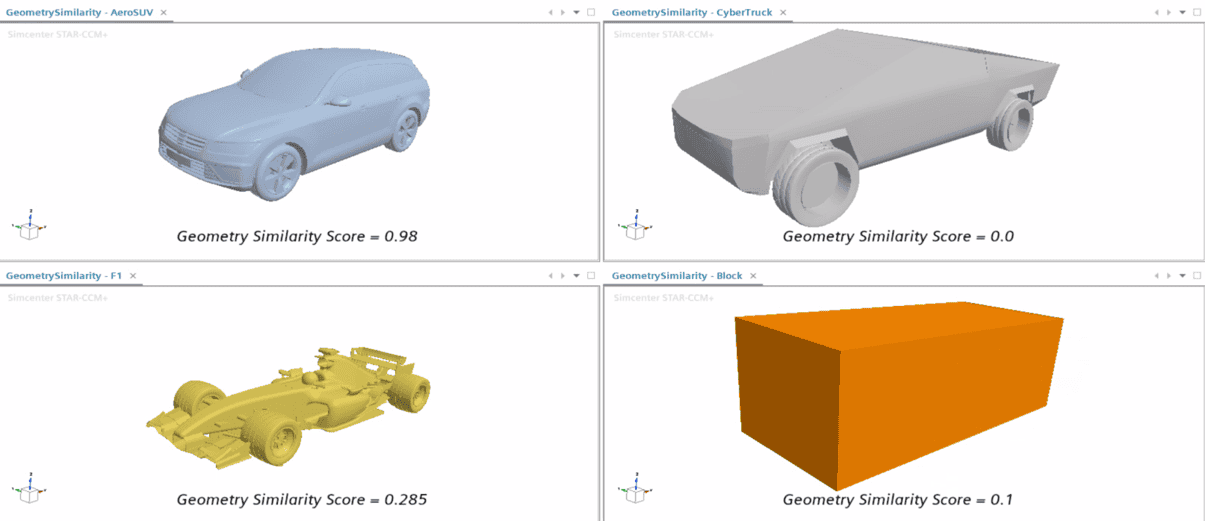
An example of the Geometry Similarity Score, comparing different shapes to the geometries used for training of a ROM
With the training set, collected from the Adaptive Sampling study, one or several ROMs can be created. Here the user has the option of selecting either surface ROMs, containing surface fields, or volume ROMs containing volume fields. Below an example of a surface field ROM is given where the model trains on the calculated surface flow fields and responses derived from these fields. Once the appropriate Design Sets and Training Dataset are selected the correct Output Fields and Responses are populated for you from the selected study.
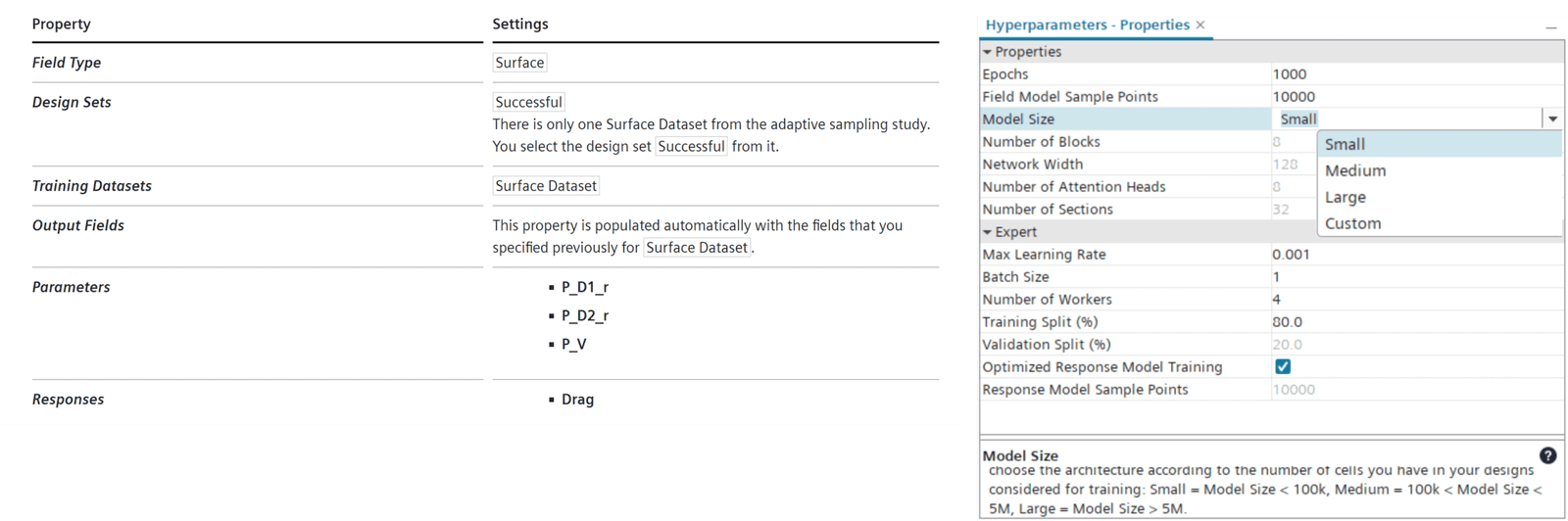
Once configured, the neural network’s hyperparameters and training criteria can be reviewed and adjusted as needed. A convenient option for modifying the network architecture is provided through a drop-down list with predefined model sizes, ranging from small to large configurations. Depending on the nature and complexity of your response space, i.e. your simulation results, hyperparameter tuning and selection of an appropriate network architecture may influence the final accuracy of the ROM. This should however be weighed against the universal fact that, put in highly academic wording, “shit in equals shit out”.
A high-quality ROM is more likely achieved through careful dataset curation to remove outliers, and ensuring that both a larger and more varied training set is used, compared to model tuning alone.
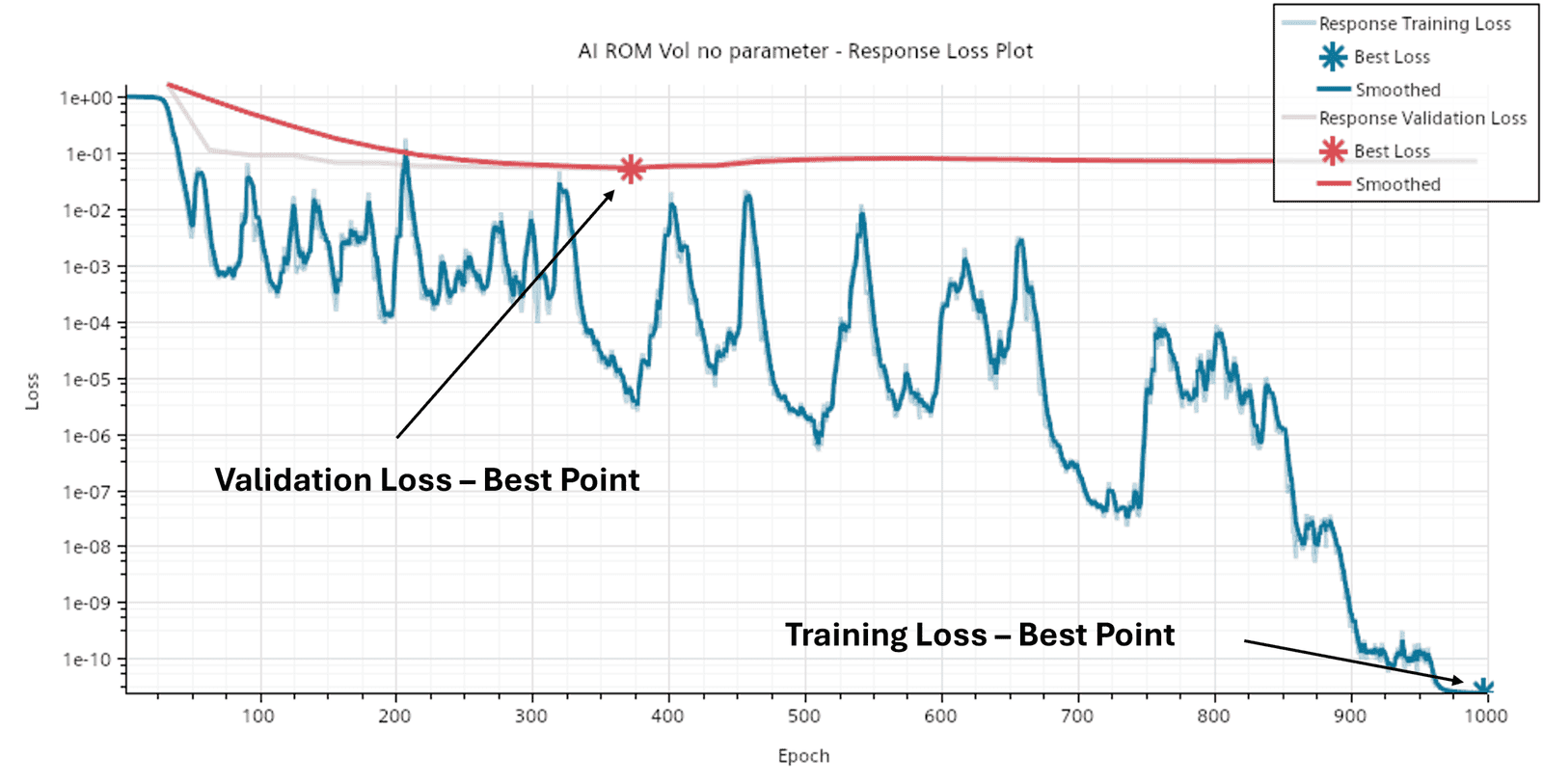
In the figure below, a Volume ROM has been run for a 1000 epochs (i.e. training iterations). Note that the y-axis is logarithmic. The lowest validation loss is observed relatively early, at around 380 epochs. This indicates that the neural network’s ability to generalize and accurately capture the behavior of the validation dataset (which consists of 20 [%] of the data not used during training) was achieved well before the lowest training loss was reached.
This is a clear example of overfitting, where the network becomes increasingly specialized to the training data, resulting in excellent performance on the training set but less so on unseen data. To get around this problem Simcenter PhysicsAI automatically selects the model with the lowest validation losses, instead of using the one trained all the way to 1000 Epochs.
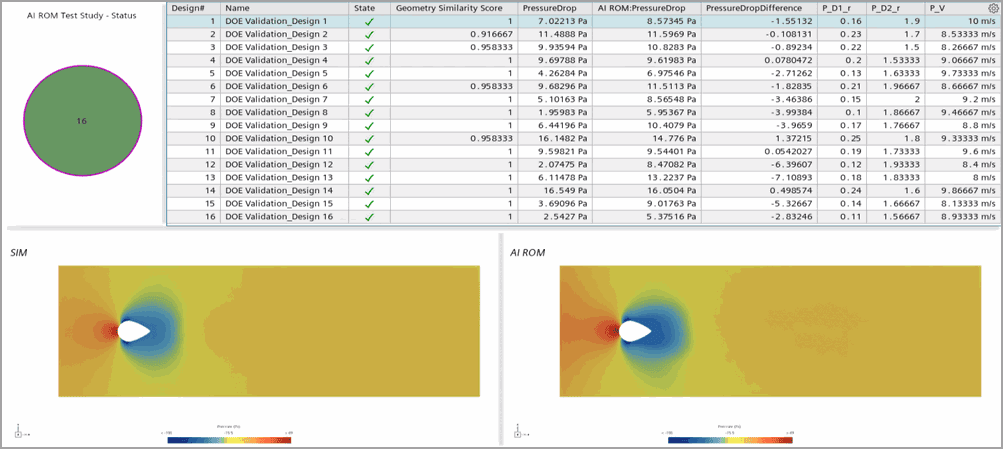
To further build confidence in a model’s ability to predict, additional validation studies can be run by creating Test Studies in Design Manger . In these studies, new simulations are executed and their results compared against the predictions made by Simcenter PhysicsAI’s ROM, as illustrated below:
Lastly, the newly created ROMs may be used for optimization studies, where the computational efficiency of the neural network is leveraged to provide design direction or rapidly identify promising design candidates. This approach offers a significant advantage over traditional direct optimization, which requires multiple computationally expensive Simcenter STAR-CCM+ simulations to be run.
As noted earlier however, the effort involved with generating training data and developing a ROM should be weighed against the cost of running full-order simulations directly with an optimization.
Hopefully, this article gave you some new insights into the realm of Reduced Order Modelling, and an introduction into the possibilities of using Simcenter PhysicsAI directly in Simcenter STAR-CCM+.
Author
Fabian Hasselby, M.sc.