
It is time again, a new version of Simcenter STAR-CCM+, this time version 2602. This release will be at the end of this month, so this post is a teaser as it is posted. With every new version, there is also a post about the multiphase news associated with that version. This time around, the Eulerian and Lagrangian Improvements and new models, are fewer, so there will be some more emphasis on the SPH (Smoothed Hydrogen Particles) news. But let’s dig into what we got.
Energy compatibility with Phasic Porous media and EMP
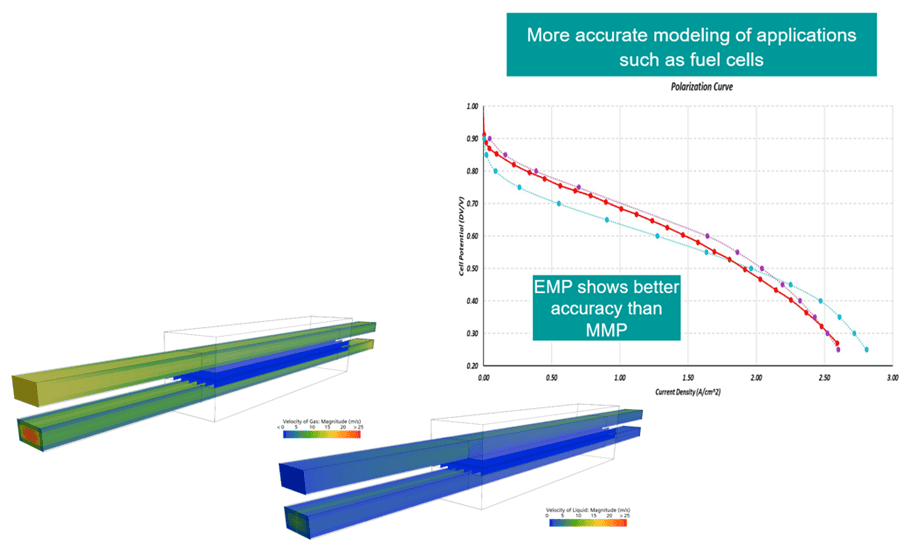
The phasic porous media was introduced last year, you can read more about it in the following posts: EMP Porous Media – Volupe.com, Simcenter STAR-CCM+ Multiphase News Version 2510 – Volupe.com. In this version it was also made compatible with the energy equation. This is a step up, as it now allows for modelling of applications such as fuel cells and electrolyzers with phasic porous media and EMP. The phasic porous media allows for complex sub-grid phenomena to be modelled where interactions with unresolved solids are important.
Updates for LMP
Track files used for Lagrangian has been updated in terms of triggers for the particle tracking. The new triggers available are complete evaporation reaction or impingement to the volume of fluid model (VOF).
Further, multicomponent material models are now compatible with parcel transfer injectors. This allows for transfer to a more optimal model when local conditions require a different model, also for multicomponent particles.
Fiber length distribution with constant segment length (DEM)
Simcenter STAR-CCM+ version 2602 introduces a new Fiber Segment Specification condition for injectors, aimed at enhancing the modeling of fibrous materials. Previously, all fibers, regardless of their actual length, were discretized into a fixed number of segments. This could lead to shorter fibers having very small individual segments, which reduced their effective bending and axial stiffness, akin to the stiffness of multiple springs connected in series. This segmentation also impacted simulation performance, as the Discrete Element Method (DEM) timestep is governed by the size of the smallest segment within the domain. Consequently, short fibers with numerous small segments would force a minimal global DEM timestep, slowing down overall computation. The new Fiber Segment Specification condition allows users to define a constant length for a segment. This is particularly useful when injecting fibers with a wide distribution of lengths, as shorter fibers will automatically comprise fewer segments. The primary technical benefits are improved physical fidelity through more accurate stiffness modeling across the full spectrum of fiber lengths, and enhanced computational efficiency, as a larger minimum segment size permits larger DEM timesteps, leading to faster simulation runtimes.
Evaporation models for non-spherical DEM particles
The influence of particle shape on dense granular flow has been extensively studied and well documented over the past two decades, making it clear that many industrial applications cannot be accurately represented using idealized spherical particles. This feature addresses that gap by enabling evaporation solution compatibility with non‑spherical particle shapes, ensuring more realistic modeling where spherical approximations are insufficient.
This animation illustrates a two-way coupled DEM-CFD simulation of a fluidized bed dryer. It depicts hot air entering the chamber at the bottom, interacting with a vibrating screen where polyhedral particles are bouncing. These particles consist of solid and liquid components, with the simulation focusing on the evaporation of the liquid component. The vapor generated by the particles in the initially dry air is visualized using an orchid-to-green color bar, where orchid indicates lower vapor mass fractions, and green represents higher mass fractions.
Smoothed Particle Hydrodynamics (SPH)
There are few interesting improvements for the SPH-solver, the first being a faster turn around time for Vehicle wading applications. The improvement comes from increased accuracy locally using particle refinement around the vehicle. Resolving the dynamic motion of the car modelling the suspension and contact between the tire and road. And, analysing mechanical stresses on the backplate of the car and wetting predictions.
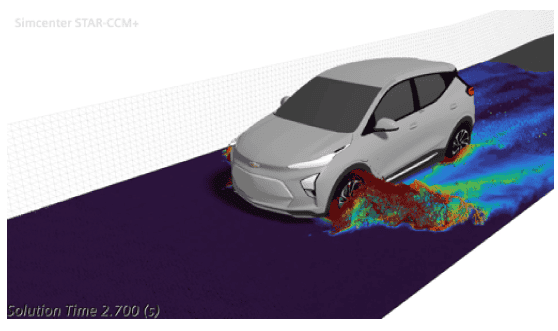
The next capability now relates to cooling applications. Siemens now release the first stage to enable the cooling applications with the introduction of the total energy conservation equation in the SPH solver.
That is to resolve the fluid temperature and compute heat transfer coefficient at the walls, as you can see in the animation. To activate this energy equation, you can now select the “Segregated Multiphase Temperature” in the Optional Models of the Continua. That allows you to set up new fluid properties with the definition of thermal conductivity and specific heat. Now, you also have access to thermal specifications at the boundary conditions. Specifically, for solid boundary conditions, you now have access to:
– Temperature: a static temperature profile can be prescribed on the boundary
– Heat Flux: a heat flux profile can be prescribed on the boundary
– Heat Source: a heat source profile can be prescribed on the boundary
– Convection: a heat transfer coefficient and an ambient temperature profile can be prescribed on the boundary
– Adiabatic: no thermal interaction
In terms of data analysis, you can now define Heat transfer reports, and several field functions are now available:
– On the fluid particles: Temperature, Total Enthalpy, Total Energy.
– On boundaries: Boundary Conduction Heat Flux, Boundary Advection Heat Flux, Boundary Heat Flux (the 3 corresponding Heat transfers), Heat Transfer Coefficient.
I hope that this has been an interesting read and can be of use for you in your CFD-endeavours. If you have any questions, reach out to support@volupe.com.
Author

Robin Victor
support@volupe.com
