
Altair Simsolid
Meshless structural analysis on full CAD assemblies — results in seconds, not hours. Volupe provides licenses, support, and training across the Nordics and Europe.
Siemens Platinum Partner
No Meshing Required
Engineering Support & Training
What is Altair Simsolid?
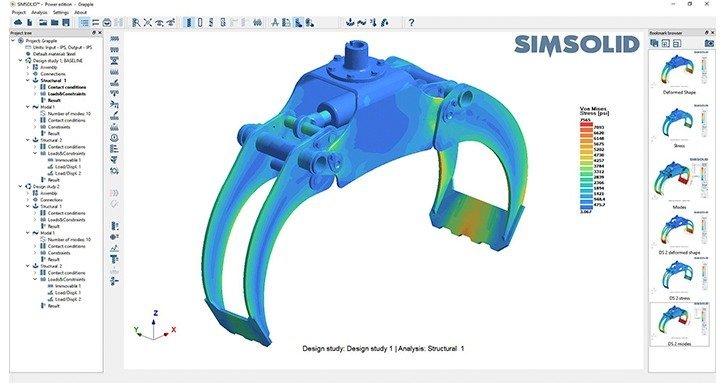
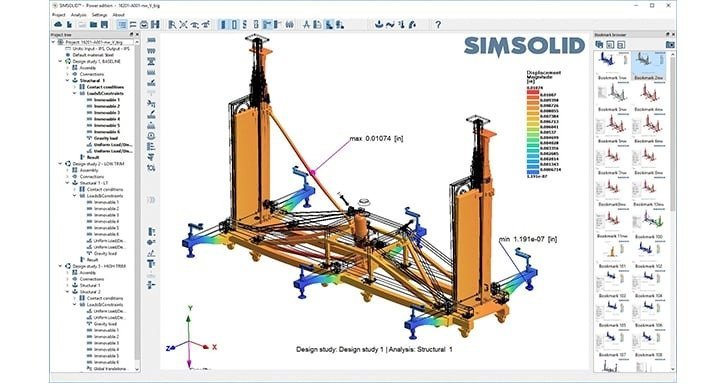
Altair SimSolid is a structural analysis tool built for speed. Unlike traditional finite element analysis (FEA), SimSolid works directly on full CAD geometry without requiring geometry simplification or mesh generation — the two most time-consuming and error-prone steps in conventional simulation. This means engineers and designers can validate structural performance within minutes on complete assemblies, straight from their CAD system.
SimSolid’s computational engine is based on a fundamentally different mathematical approach: the theory of external approximations. Instead of dividing geometry into finite elements, SimSolid uses arbitrary geometrical shapes as computational regions and applies adaptive multi-pass analysis to control accuracy. The result is a solver that handles large assemblies with hundreds or thousands of parts on a standard desktop PC, delivering accurate stress, displacement, and modal results in seconds to minutes.
With the 2025 Siemens acquisition of Altair, SimSolid is now part of the Siemens Xcelerator platform. As a Siemens Platinum Smart Expert Solutions Partner, Volupe bridges both the Simcenter and Altair simulation portfolios — giving you a single point of contact for licenses, training, and technical suppor
Why Simsolid?
No Geometry Simplification. No Meshing.
Traditional FEA requires engineers to clean up CAD geometry, remove small features, repair surfaces, and generate a mesh before any analysis can begin. This process often takes longer than the analysis itself and demands specialist knowledge. SimSolid eliminates both steps entirely. Import the CAD model as-is — with fillets, small holes, bosses, and imperfect surfaces — and start solving immediately. This makes it practical for designers and design engineers to run simulation themselves, not just dedicated analysts.
Accurate Results in Seconds to Minutes
SimSolid’s multi-pass adaptive solver delivers converged structural results dramatically faster than traditional FEA. Typical solution times are measured in seconds to minutes, even for large assemblies with complex contacts. This speed allows engineers to evaluate multiple design alternatives quickly, catch problems early, and iterate faster — all on a standard workstation without requiring HPC clusters or cloud compute.
Built for Large Assemblies
SimSolid was designed from the ground up as a large-assembly solver. It handles models with hundreds to thousands of parts, including assemblies with rough contact surfaces, gaps, and overlapping geometry that would be impractical for traditional FEA. Automatic contact detection identifies part-to-part connections, and the solver efficiently manages memory and compute resources to deliver results on desktop-class hardware.
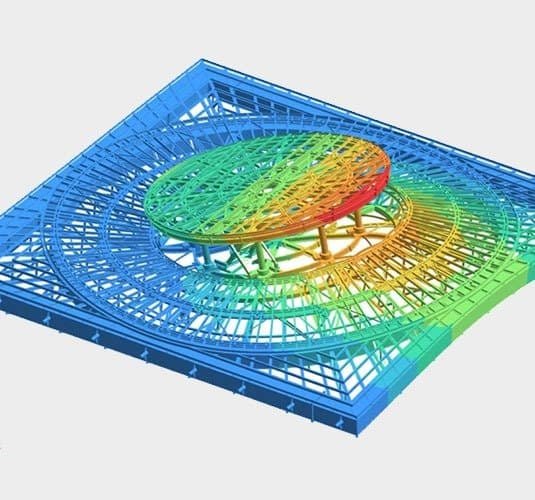
No Meshing Required — Analyze full CAD assemblies directly, without geometry simplification.
SimSolid Cloud
Altair SimSolid is also available as a cloud-native application, accessible from any web browser without local software installation. SimSolid Cloud delivers the same meshless technology for linear and nonlinear statics, modal vibration, and thermal stress analysis — with the added benefit of browser-based collaboration and no hardware requirements. This makes it ideal for distributed teams, occasional users, or organizations that want to deploy simulation without managing desktop installations.
SimSolid vs Traditional FEA
The core difference is workflow. In traditional FEA, the simulation model must be built separately from the CAD model — geometry is defeatured, meshed, and checked before analysis can begin. This process often accounts for 60–80% of total analysis time. SimSolid removes this bottleneck entirely by working directly on the native CAD geometry.
This does not mean SimSolid replaces all FEA. For highly specialized analyses — such as detailed crack propagation, hyperelastic material models, or explicit crash simulation — traditional tools like OptiStruct, Nastran, or Abaqus remain the right choice. SimSolid excels as a rapid validation tool during design, for concept evaluation, for large-assembly structural checks, and for scenarios where turnaround time matters more than specialist solver features. Many teams use SimSolid for 80% of their simulation tasks and reserve traditional FEA for the remaining 20%. For teams that need detailed mesh-based pre-processing, Altair HyperMesh is the natural complement.

Altair HyperMesh Features
CAD Import and Automatic Part Classification
SimSolid reads all major CAD and PLM file formats natively, including CATIA, NX, PTC Creo, Inventor, Fusion 360, SOLIDWORKS, JT, STEP, VDA, Parasolid, ACIS, PLMXML, CGR, and STL. No file conversion or geometry translation is needed. On import, SimSolid automatically classifies parts by type — solid, thin, beam-like, or protruded — and applies appropriate computational settings. Direct integration with Onshape and Siemens Teamcenter provides seamless data access for teams working in managed PLM environments.
Meshless Technology
SimSolid’s computational engine eliminates meshing entirely. Instead of discretizing geometry into finite elements, SimSolid uses the theory of external approximations — a generalization of FEM where arbitrary geometrical shapes serve as computational regions and basis functions are independent of volume shape. The geometry is decomposed into regions, and computational detail is added adaptively only where needed — near high gradients, small features, fillets, and narrow gaps. This approach removes the single largest time sink in traditional FEA and eliminates a major source of user error.
Multi-Pass Adaptive Solver
SimSolid uses a multi-pass adaptive analysis to control solution accuracy automatically. Adaptivity operates on both a global and part-local basis and is always active. Each pass refines the solution in regions where error indicators are highest, enriching the approximation until convergence criteria are met. Engineers can adjust the number of adaptive passes and choose between adaptation objectives — stiffness-based for load path prediction and modal analysis, or stress-based for detailed stress results. No manual mesh convergence studies are needed.
Linear Static Analysis
Evaluate stress, strain, displacement, and safety factors under static loading conditions. SimSolid supports a wide range of boundary conditions including immovable, sliding, and hinge constraints, as well as force, pressure, gravity, thermal loads, bearing loads, hydrostatic pressure, and remote loads. Multiple load cases can be defined, superposed, and enveloped within a single analysis. Results are typically available in seconds for single parts and minutes for large assemblies.
Nonlinear Static Analysis
SimSolid supports three types of nonlinearity: contact nonlinearity (separating contacts with friction), geometric nonlinearity (large deformations), and material nonlinearity (elasto-plastic response). These can be combined for coupled nonlinear analysis. Bolt preload is handled through a dedicated workflow — select the nuts, define thread pitch and target axial force, and SimSolid automatically applies the preload using an iterative displacement method. This is particularly valuable for bolted flange analysis, clamped joint evaluation, and weld assessment.
Modal Analysis
Calculate natural frequencies, mode shapes, and participation factors for parts and assemblies. Modal analysis in SimSolid runs with the same meshless speed advantage — hundreds of modes on a large assembly in minutes. Results help engineers identify resonance risks, validate stiffness targets, and understand dynamic behavior early in the design process. SimSolid also supports Craig-Bampton superelement export, allowing modal reduction models to be integrated into larger system-level FE analyses using traditional tools like OptiStruct or Nastran.
Thermal Analysis
SimSolid supports both steady-state and transient thermal simulation, including temperature-dependent material properties, heat flux, convection, and volumetric heat generation. Thermal results can be linked to structural analysis for coupled thermal-stress evaluation — essential for products that operate under varying temperature conditions. The 2025.1 release added adapt-to-features for thermal analysis, improving resolution in regions with high temperature gradients, and supports initial temperatures defined on a per-part basis.
Dynamic Analysis
Beyond modal analysis, SimSolid supports a full range of dynamic simulations: frequency response (harmonic), linear transient (time-domain), random response, and partial dynamic response. Squeak and rattle analysis identifies potential NVH issues in assemblies. These capabilities enable engineers to evaluate vibration performance, shock response, and fatigue life under realistic dynamic loading — all with the same meshless speed advantage that makes SimSolid unique.
Fatigue Analysis
SimSolid includes fatigue analysis for predicting component life under cyclic loading. Combined with the ability to run multiple load cases and compare design variants quickly, this allows engineers to screen designs for fatigue performance early in the development process — before committing to expensive prototype testing. Stress linearization is also available for pressure vessel assessment in compliance with design codes.
Connections and Fasteners
SimSolid provides automatic contact detection with support for bonded, sliding, and separating contacts with friction. Specialized connection types include bolts with preload, spot welds, solid seam welds, fillet welds, rivets, adhesives, virtual connectors, joints, and bushings. The 2025 release added automatic fastener detection for coaxial holes, reducing manual setup time for bolted assemblies. All connections can be reviewed and edited both graphically and in tabular form — practical for assemblies with hundreds of connections.
Composites Analysis
SimSolid supports composite material analysis for layered structures, including orthotropic material definitions. This extends SimSolid’s applicability to industries where composite laminates are common — aerospace, automotive, marine, and sporting goods. While dedicated composite tools in HyperMesh offer more detailed ply-level control, SimSolid provides fast structural screening of composite designs during early concept evaluation.
Design Comparison and Part Replacement
SimSolid makes it easy to compare multiple design iterations. Each variant is stored as a separate Design Study within the same project, and the analysis setup — loads, boundary conditions, contacts — is automatically replicated from a baseline study. The 2025.1 release added part replacement: right-click any part and swap it for a modified design, with all existing attributes and connections preserved automatically. This streamlines the “what if” workflow that is central to simulation-driven design.
Why Volupe for Altair Simsolid?
Simcenter + Altair
Fast Response Times
Nordic & European Reach
Want to discuss licensing or book a demo?
SimSolid is licensed through Altair Units — a flexible, token-based model that gives you access to the full Altair HyperWorks product suite with a single pool of units. This means you can use SimSolid alongside other Altair tools like HyperMesh, OptiStruct, and Inspire without separate license purchases. Pricing depends on the number of units and contract terms. Contact Volupe for a tailored quote based on your team's needs.
SimSolid reads all major CAD and PLM formats natively, including CATIA, NX, PTC Creo, Inventor, Fusion 360, SOLIDWORKS, JT, STEP, VDA, Parasolid, ACIS, PLMXML, CGR, and STL. No file conversion is required. SimSolid also offers direct integration with Onshape and Siemens Teamcenter for teams working in managed PLM environments.
SimSolid has been extensively benchmarked against traditional FEA solvers and NAFEMS standard test cases. For the analysis types it supports — linear and nonlinear statics, modal, thermal, dynamics — results are within a few percent of conventional solvers like Nastran, OptiStruct, and Abaqus. The multi-pass adaptive solver automatically refines accuracy, and engineers can increase the number of adaptive passes for higher precision. SimSolid is not intended to replace all FEA — for highly specialized analyses like explicit crash, hyperelastic materials, or crack propagation, traditional solvers remain the right choice.
SimSolid covers a broad range of structural and thermal simulations: linear statics, nonlinear statics (contact, material, geometric), modal analysis, thermal (steady-state and transient), coupled thermal-stress, frequency response, transient dynamics, random response, buckling, fatigue, composites, squeak and rattle, stress linearization, bolt preload, and inertia relief. Craig-Bampton superelement export is also supported for integration with traditional FE workflows.
Yes — SimSolid was built specifically as a large-assembly solver. It routinely handles models with hundreds to thousands of parts on a standard desktop PC. Assemblies with rough contact surfaces, gaps, and overlapping geometry are handled without issues. Industrial case studies include full vehicle body structures, 33-meter rotating kilns, offshore reel assemblies, and complete steel frame constructions.
No. SimSolid is entirely meshless. It works directly on the native CAD geometry without any mesh generation or geometry simplification. This is the core technology difference that gives SimSolid its speed and ease-of-use advantages. The solver uses the theory of external approximations — a mathematical generalization of FEM — to compute results directly on the geometric shapes.
HyperMesh is a full-featured FE pre- and post-processor for traditional mesh-based analysis. It gives analysts detailed control over geometry, meshing, solver setup, and post-processing across multiple solver formats. SimSolid, on the other hand, is a standalone meshless solver for rapid structural validation on full CAD assemblies. Many teams use both: SimSolid for fast design-phase screening and HyperMesh for detailed certification-level analysis.
SimLab is an automated, CAD-associative simulation environment that still uses mesh-based FEA but automates much of the setup through templates and wizards. It maintains associativity with the CAD model so that design changes propagate automatically. SimSolid eliminates meshing entirely and focuses on speed. SimLab is a good choice for repeated, standardized analysis workflows; SimSolid is best for rapid concept evaluation and large assemblies where meshing is the bottleneck.
Yes. Altair SimSolid Cloud is a cloud-native application accessible from any web browser. It supports linear and nonlinear statics, modal vibration, and thermal-stress analysis without requiring local software installation. SimSolid Cloud is available through the Altair One marketplace.
Yes. SimSolid supports bolt preload with an automated workflow — define the nuts, thread pitch, and target force, and SimSolid handles the rest. It also supports spot welds, solid seam welds, fillet welds, rivets, adhesives, virtual connectors, joints, and bushings. The 2025 release added automatic fastener detection for coaxial holes, further reducing setup time for bolted assemblies.
Yes. Volupe offers training courses for SimSolid ranging from introductory sessions to advanced workshops covering nonlinear analysis, dynamic simulation, and workflow optimization. Training is available as on-site sessions, online live courses, or customized programs tailored to your team's industry and applications. Contact us to discuss your training needs.
Yes. Following Siemens' acquisition of Altair in 2025, SimSolid is now part of the Siemens Xcelerator platform. As a Siemens Platinum Smart Expert Solutions Partner, Volupe provides licenses, support, and training for both the Simcenter portfolio and the Altair product suite — including SimSolid — through a single partner relationship.
Altair SimSolid for Your Industry
SimSolid’s meshless approach and rapid solve times make it valuable across any industry where structural validation is needed on complex assemblies. Below are some of the sectors where SimSolid has the greatest impact — many of which are core to Volupe’s customer base.
-
Heavy Equipment and Industrial Machinery
Heavy Equipment and Industrial Machinery
Heavy equipment manufacturers deal with large welded structures, bolted assemblies, and complex load paths that are time-consuming to mesh and analyze with traditional FEA. SimSolid handles these assemblies directly — from excavator booms and crane structures to conveyor systems and industrial furnaces. Engineers can evaluate structural integrity, weld fatigue, and bolt preload performance without spending days on geometry cleanup and meshing.
Typical applications: Boom and arm structural analysis, welded frame evaluation, bolted flange and joint analysis, ROPS/FOPS cab safety assessment, vibration and NVH evaluation, hydraulic cylinder mounting analysis, and large-assembly buckling checks. Swedish customers like Vinab have used SimSolid to analyze structures as large as a 33-meter rotating kiln — an analysis that would be impractical with traditional FEA on a desktop workstation.
-
Automotive
Automotive
In automotive development, SimSolid enables design engineers to validate structural performance early — before handing off to dedicated CAE teams for detailed crash and NVH analysis. Its speed makes it ideal for concept screening, design comparison, and rapid iteration on body-in-white structures, battery enclosures, interior assemblies, and powertrain components. Teams can evaluate multiple design alternatives in the time it traditionally takes to set up a single FEA model.
Typical applications: Body structure stiffness evaluation, battery pack and module structural assessment, interior trim and dashboard assemblies, powertrain mounting bracket analysis, weld and fastener load checks, modal analysis for NVH screening, thermal-stress evaluation of electronics housings, and supplier part qualification. Röchling Automotive has used SimSolid to accelerate development of battery cooling system components, eliminating tedious mesh generation while maintaining result accuracy.
-
Marine and Offshore
Marine and Offshore
Marine structures — hull frames, superstructures, offshore platforms, and subsea equipment — are large, complex, and traditionally expensive to simulate. SimSolid’s ability to analyze full assemblies without simplification is a natural fit for this industry. Engineers can evaluate global structural behavior and local stress concentrations in the same model, without the idealization to shell or beam elements that traditional FEA often requires.
Typical applications: Hull structural analysis, deck and superstructure evaluation, offshore platform and jacket structural assessment, subsea equipment frames, weld fatigue in classification society context (DNV, Lloyd’s, Bureau Veritas), crane and lifting equipment on vessels, and large-assembly structural checks for shipyard tooling. TechnipFMC has published multiple case studies using SimSolid for offshore reel analysis, OBN seismic systems, and bolted connection evaluation in the oil and gas sector.
-
Aerospace and Defense
Aerospace and Defense
While aerospace certification workflows often require dedicated FEA tools like HyperMesh and OptiStruct, SimSolid plays a valuable role earlier in the design process. It allows structural engineers to screen airframe concepts, evaluate bracket designs, check tooling fixtures, and perform rapid trade studies — all without investing hours in mesh generation. The speed advantage is particularly useful during preliminary design reviews and for supplier structural assessments.
Typical applications: Airframe concept screening, bracket and fitting evaluation, tooling and fixture structural checks, satellite and spacecraft component analysis, landing gear preliminary assessment, and defense vehicle structural evaluation. Astra used SimSolid to accelerate product development for rocket launch systems, producing results in a tenth of the time compared to their previous in-house tools.
-
Consumer Products and Electronics
Consumer Products and Electronics
Product designers in consumer goods and electronics benefit from SimSolid’s low barrier to entry. No specialist FEA knowledge is needed to import a CAD model, apply loads and constraints, and get meaningful structural results. This makes simulation accessible to design teams who previously relied on physical prototypes or waited for analyst availability. SimSolid is also extending its meshless technology to PCB and IC simulation — bringing the same speed advantages to the electronics domain.
Typical applications: Housing and enclosure structural evaluation, drop and impact screening, snap-fit and clip analysis, thermal-stress assessment of electronics assemblies, connector reliability, and lid/cover stiffness checks. The upcoming PCB/IC simulation capability will enable thermal and structural analysis of circuit boards and integrated circuits without traditional meshing constraints.
-
Architecture, Engineering, and Construction
Architecture, Engineering, and Construction
Steel structures, facades, and industrial constructions often consist of hundreds of welded and bolted parts that are challenging to analyze as complete assemblies. SimSolid enables structural engineers to evaluate these designs in full detail — including all connections, brackets, and secondary steelwork — without reducing the model to idealized beam or shell elements. Mecon, a Swedish steel fabricator, reduced their structural analysis time from one week to four hours using SimSolid, while also enabling compliance checking against Eurocode 3 for steel structures.
Typical applications: Steel frame and truss analysis, facade panel and support structure evaluation, walkway and platform structural checks, lifting lug and connection design, welded joint assessment, bolted connection analysis per Eurocode, and rapid structural screening for tender and quotation work.
Heavy Equipment and Industrial Machinery
Heavy equipment manufacturers deal with large welded structures, bolted assemblies, and complex load paths that are time-consuming to mesh and analyze with traditional FEA. SimSolid handles these assemblies directly — from excavator booms and crane structures to conveyor systems and industrial furnaces. Engineers can evaluate structural integrity, weld fatigue, and bolt preload performance without spending days on geometry cleanup and meshing.
Typical applications: Boom and arm structural analysis, welded frame evaluation, bolted flange and joint analysis, ROPS/FOPS cab safety assessment, vibration and NVH evaluation, hydraulic cylinder mounting analysis, and large-assembly buckling checks. Swedish customers like Vinab have used SimSolid to analyze structures as large as a 33-meter rotating kiln — an analysis that would be impractical with traditional FEA on a desktop workstation.
Automotive
In automotive development, SimSolid enables design engineers to validate structural performance early — before handing off to dedicated CAE teams for detailed crash and NVH analysis. Its speed makes it ideal for concept screening, design comparison, and rapid iteration on body-in-white structures, battery enclosures, interior assemblies, and powertrain components. Teams can evaluate multiple design alternatives in the time it traditionally takes to set up a single FEA model.
Typical applications: Body structure stiffness evaluation, battery pack and module structural assessment, interior trim and dashboard assemblies, powertrain mounting bracket analysis, weld and fastener load checks, modal analysis for NVH screening, thermal-stress evaluation of electronics housings, and supplier part qualification. Röchling Automotive has used SimSolid to accelerate development of battery cooling system components, eliminating tedious mesh generation while maintaining result accuracy.
Marine and Offshore
Marine structures — hull frames, superstructures, offshore platforms, and subsea equipment — are large, complex, and traditionally expensive to simulate. SimSolid’s ability to analyze full assemblies without simplification is a natural fit for this industry. Engineers can evaluate global structural behavior and local stress concentrations in the same model, without the idealization to shell or beam elements that traditional FEA often requires.
Typical applications: Hull structural analysis, deck and superstructure evaluation, offshore platform and jacket structural assessment, subsea equipment frames, weld fatigue in classification society context (DNV, Lloyd’s, Bureau Veritas), crane and lifting equipment on vessels, and large-assembly structural checks for shipyard tooling. TechnipFMC has published multiple case studies using SimSolid for offshore reel analysis, OBN seismic systems, and bolted connection evaluation in the oil and gas sector.
Aerospace and Defense
While aerospace certification workflows often require dedicated FEA tools like HyperMesh and OptiStruct, SimSolid plays a valuable role earlier in the design process. It allows structural engineers to screen airframe concepts, evaluate bracket designs, check tooling fixtures, and perform rapid trade studies — all without investing hours in mesh generation. The speed advantage is particularly useful during preliminary design reviews and for supplier structural assessments.
Typical applications: Airframe concept screening, bracket and fitting evaluation, tooling and fixture structural checks, satellite and spacecraft component analysis, landing gear preliminary assessment, and defense vehicle structural evaluation. Astra used SimSolid to accelerate product development for rocket launch systems, producing results in a tenth of the time compared to their previous in-house tools.
Consumer Products and Electronics
Product designers in consumer goods and electronics benefit from SimSolid’s low barrier to entry. No specialist FEA knowledge is needed to import a CAD model, apply loads and constraints, and get meaningful structural results. This makes simulation accessible to design teams who previously relied on physical prototypes or waited for analyst availability. SimSolid is also extending its meshless technology to PCB and IC simulation — bringing the same speed advantages to the electronics domain.
Typical applications: Housing and enclosure structural evaluation, drop and impact screening, snap-fit and clip analysis, thermal-stress assessment of electronics assemblies, connector reliability, and lid/cover stiffness checks. The upcoming PCB/IC simulation capability will enable thermal and structural analysis of circuit boards and integrated circuits without traditional meshing constraints.
Architecture, Engineering, and Construction
Steel structures, facades, and industrial constructions often consist of hundreds of welded and bolted parts that are challenging to analyze as complete assemblies. SimSolid enables structural engineers to evaluate these designs in full detail — including all connections, brackets, and secondary steelwork — without reducing the model to idealized beam or shell elements. Mecon, a Swedish steel fabricator, reduced their structural analysis time from one week to four hours using SimSolid, while also enabling compliance checking against Eurocode 3 for steel structures.
Typical applications: Steel frame and truss analysis, facade panel and support structure evaluation, walkway and platform structural checks, lifting lug and connection design, welded joint assessment, bolted connection analysis per Eurocode, and rapid structural screening for tender and quotation work.
