Multiphase modeling capabilities in Simcenter STAR-CCM+

Robin VictorSenior Application Specialist
Written in 2021. Menus and defaults may differ in newer releases.
In short
Simcenter STAR-CCM+ has Eulerian models (VOF, EMP, MMP, DMP) that treat a phase as a volume fraction, Lagrangian models (LMP, DEM) that track particles, plus fluid film and meshfree SPH. The right choice depends on the flow, and models can be combined, for example droplets that form a film on a wall.
In this week’s blog post we will take a look at the multiphase modelling capabilities in Simcenter STAR-CCM+. Seeing as one of the overall strengths in Simcenter STAR-CCM+ is its wide multiphysics and multiphase possibilities, it is of importance to the users of the software to be aware of these possibilities. Not only that, but it is also of great interest for us at Volupe as provider and supporting body of the software, that our clients, current and future, know what is possible to simulate.
It is important to understand the division between “multiphase” from “multi-component”. They are diametrically opposite when speaking of mixing scale. While the multiphase simulations try to simulate and resolve the interaction between your phases, the multi-component flow is already mixed on a molecular level. Meaning that the multi-component flow is seen as one phase since the mixing scale is usually too small to resolve in a CFD simulation. You can of course include multi-component phases in your multiphase simulation.
Introduction to multiphase
Multiphase simulations are important because they are found in a wide range of applications, both industrial and academic. This provides a need for the capabilities of this type of simulations in a multiphysics CFD code such as Simcenter STAR-CCM+. In Simcenter STAR-CCM+, not only do you have the option of selecting in a wide range of models, but there are unique options of combining these models in several ways.
When speaking of multiphase, what is referred to is generally the thermodynamic phase, such as solid, liquid or gas when interaction with another distinct phase. You usually discuss multiphase in two very different approaches, the Eulerian multiphase approach and the Lagrangian multiphase approach. The difference of these two approaches is the way the phase is perceived. In the Eulerian multiphase approach, the observer considers the particles, bubbles, or droplets to be a continuum passing through a fixed volume. In the Lagrangian multiphase approach the observer tracks parcels of particles (or separate particles) as they move through space and time. Each of these overall viewpoints in turn have several models to solve more specified multiphase applications. More on this later.
Eulerian or Lagrangian?
The two frameworks differ in what the solver follows.
- Eulerian: the solver looks at fixed cells and accounts for what flows in and out of each one. A dispersed phase such as bubbles, droplets or particles is treated as a continuum and described by its volume fraction, not as individual particles.
- Lagrangian: the solver follows particles, or parcels that each stand for a group of identical particles, as they move through the domain, and accounts for how each one affects and is affected by the continuous phase.
The framework is a modelling choice, separate from the flow type (dispersed or stratified). Droplets, for example, are usually tracked as Lagrangian parcels with LMP, but they can also be resolved with the Eulerian VOF model. The two frameworks can also be combined in one simulation, for instance when Lagrangian droplets hit a wall and form a fluid film.
Another subdivision of multiphase flow is to characterise them by if or not they occupy disconnected regions of space. What this means, is if you consider your flow and can find separate clusters of a phase well separated from other clusters of the same phase. This is typically the case when speaking of dispersed flow. If flow is not dispersed, it is instead continuous. Examples of dispersed flow are bubbly flow, droplets, and particle flow. Typically for instance bubbles are very much separated from each other in another phase.
The other part of this division is the stratified flow. A bit simplified you could say that this is when the flow can be divided into layers. Typical examples of this are free surface flows or annular film flow in pipes.
In Simcenter STAR-CCM+ there are seven distinct models, to meet the requirements of being able to define most types of both dispersed and stratified flows. Since version 2402 there is also an SPH solver, described below. The picture below shows the models and to what framework they belong (Eulerian or Lagrangian). Note that it is important to understand the differences between the subdivisions. The model types belong either to the Eulerian or Lagrangian framework, while the different flow types are either dispersed or stratified speaking of multiphase flow. Even if a specific type of flow (droplets for example) is typically done with the Lagrangian approach model LMP, that does not mean that you cannot instead use the Eulerian approach for that simulation (for example you can use VOF model to resolve droplets).

Which model for which flow
The table sums up the seven models described in this post and the meshfree SPH solver that Simcenter STAR-CCM+ gained in version 2402. It shows what each model is built for; to choose a model for your own case, follow the flow chart in Multiphase model selection in Simcenter STAR-CCM+.
| Model | Framework | Built for | Read more |
|---|---|---|---|
| LMP, Lagrangian multiphase | Lagrangian | Droplets, bubbles or particles carried by a continuous phase, solved as representative parcels; in this post, droplets that hit the walls and form a film | Parcels and particles in Simcenter STAR-CCM+ |
| Fluid film | Eulerian | Thin liquid films on walls, solved on a shell with an assumed velocity and temperature profile across the film; can hand over to VOF at a set volume fraction | Wall bound Lagrangian droplets |
| DEM, discrete element model | Lagrangian, an extension of LMP | Individual particles with particle–particle and particle–wall contacts, including shapes from 3D-CAD; for example pills, capsules and food particles | DEM Particle wall-link |
| EMP, Eulerian multiphase | Eulerian | The most complete model, with mass, momentum and energy equations for each phase; for example bubbles in water and fluidised beds | How to succeed with your EMP simulation in Simcenter STAR-CCM+ |
| MMP, mixture multiphase | Eulerian, simplified from EMP | Suspension-like flows solved as one mixture, with separate phase fractions and optional slip; with the large scale interface (LSI) model, free surfaces and mixtures together | What if VOF doesn´t work? MMP-LSI |
| DMP, dispersed multiphase | Eulerian, with Lagrangian aspects | A heavily dispersed phase that follows the main flow, one-way coupled by default; for example automotive soiling and aerospace icing | Multiphase model selection in Simcenter STAR-CCM+ |
| VOF, volume of fluid | Eulerian | Two or more immiscible fluids with a sharp interface; for example free surfaces in the marine industry, sloshing and wading | Some VOF solver settings in Simcenter STAR-CCM+ |
| SPH, smoothed particle hydrodynamics | Meshfree particles, outside the Eulerian and Lagrangian frameworks | The liquid as particles, with no volume mesh; highly dynamic free surfaces such as gearbox lubrication | A closer look at the SPH solver in Simcenter STAR-CCM+ |
Multiphase interactions
One of the relative strengths of Simcenter STAR-CCM+ when it comes to multiphase simulations lies in its wide range of multiphase interactions. This means that you can combine different multiphase models in a simulation. You can choose a set of models to use, and specify top level models to create interactions between the different phases. As an example, the Lagrangian particles, or parcels, can interact with a fluid film located on wall boundary. This interaction can be described by several different impingement models. The opposite is possible as well, your fluid film model can strip back into the LMP framework. Note that this allows you to use both Eulerian and Lagrangian framework models in the same simulation. As there are many multiphase interactions possible, they will not all be handled here in detail.
The different models
In this section we will go through the different models and some typical applications for these models where they are beneficial to use, both in terms of capturing a specific flow phenomenon but also in terms of reducing the complexity of a specific problem. Like mentioned above, it is possible to resolve droplets explicitly in a Eulerian manner using the VOF model, it is also possible to simulate droplets in a Eulerian manner, where droplets are simulated with distribution function and the result you get on your continuous phase is average (since the interface is not explicitly simulated). The approach could then be EMP or MMP. Further, droplets could with benefit be simulated as liquid particles using the LMP approach. You must always ask what you want from your simulation to decide how to setup your multiphysics problem. It is also connected to resolution and computational power. You will place your simulation somewhere between under resolved and too expensive to compute.
LMP
The Lagrangian multiphase model is a subgrid model that models dispersed phases moving through a continuous phase. The equations of motion are solved for representative parcels of the dispersed phase passing through the system. LMP is beneficial to use when the main flow is defined by a continuous phase and the dispersed phase is relatively low in volume fraction (up to about 10%). There are several different interactions with other models that can be used with LMP. The film below shows how droplets injected counter to a continuous phase interact with the walls to form fluid film on the walls. The thickness of the fluid film can be observed, and edge stripping occurs where the fluid film transfers back to the LMP phase. Further, what might be hard to spot, is that the particles interact with the continuous phase and are evaporating as well.
Fluid film
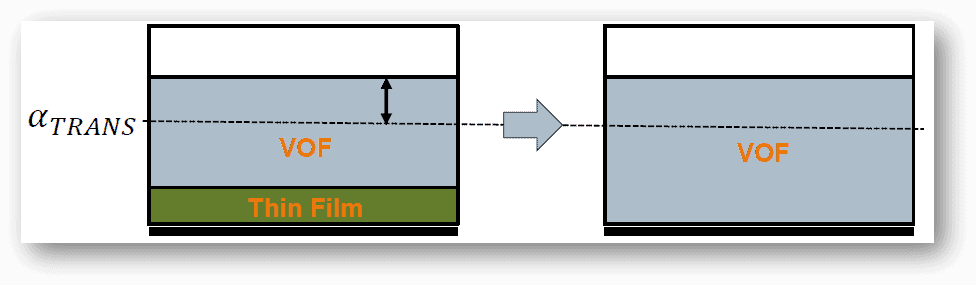
The fluid film model falls within the Eulerian framework and uses boundary layer approximations to predict the dynamic characteristic behaviour of wall films. The fluid film model is not a 2D-model type, but it is simulated on a thin shell of a solid wall. This wall can very well be a 3D-structure. However, the fluid film model assumes a velocity and temperature profile along the depth of the film and is not explicitly simulated. The fluid film model is often a good approximation of thinly formed fluids on solid structures that does not require full resolution through thin phase-structures. It can favourably be combined with VOF to allow for transition between fluid film and VOF at a user defined volume fraction.
DEM
The Discrete Element Model (DEM) is an extension of the Lagrangian multiphase model (LMP), that allows for more detailed simulation of individual particles. Instead of simulating parcels representing a cluster of particles, the DEM method will look at interactions between particles and interactions with particles and other boundaries. There are several particle models that can be simulated in Simcenter STAR-CCM+, where predefined shape models can be selected. You can also define your own arbitrary shape from 3D-CAD. You can include bonding between particles, simulated like emulating straws of grass or sheets of ice. Typical applications include simulation where inter particle interactions is of interest, like pills, capsules, or food particles. Note that this is an expensive way of performing simulations, because each contact is modelled in detail, and the number of contacts and collisions, and so the cost, grows quickly with the number of particles. For large bulk-material systems, Siemens also offers Simcenter EDEM, a dedicated DEM code with GPU and multi-GPU solvers for many millions of particles and pre-calibrated material models for rocks, ores, soils and powders.
EMP
The Eulerian multiphase model is the most complete, and therefore also the most advanced model when it comes to multiphase modelling. Conservation equations for mass, momentum and energy are treated for each phase separately, increasing the number of equations solved. Phases interact based on the contact area between the phases, making the length scales of your phases important, whether they are represented by dispersed or stratified flows. Running pure EMP simulations are in theory possible for all type of multiphase flows (including dispersed solids, for example fluidised beds), but there might be models that are better suited for the problem, since other models might capture the physics without being too computationally heavy.
MMP
The mixture multiphase model is an example of a simplified model type that originates in the EMP model. It can be used to model suspension-like multiphase flows. The assumption in this model is that the suspension is a homogenous single-phase system. This holds true when you can use weighted physical properties to represent a mixture of phases and solve momentum, mass, and energy for the mixture, but the phase fractions of the different phases are solved separately. You can also model slip velocity between phases.
DMP
The Dispersed multiphase model is a simplified model that focuses on a heavily dispersed phase in a continuous flow (a volume fraction of about 1% or less). The dispersed phase can be in any thermodynamic state, like gas, liquid or solid and is expected to follow the main flow. The coupling between phases is per default one-way, but a two-way coupling can be activated. The model works in a Eulerian manner but has aspects of the Lagrangian framework in its modelling of the disperse phase. Typical applications are automotive soiling and aerospace icing. In the video below the DMP model is combined with fluid film to simulate water droplets as the dispersed phase on a car windshield.
VOF
Volume of fluid is a model used to simulate two or more immiscible fluids, immiscible being the operative word. This model works best when each phase is represented by a large structure in the system. Meaning that the phase can be separated by a clear and sharp interface, typically free surface flow. What is of interest in VOF simulations are typically the movement of the interface between phases, making it a good option in the marine industry, but also for sloshing and wading simulations. The VOF method is an interface-capturing method: it tracks the volume fraction of each phase in every cell, which locates the interface between the phases.
SPH: the meshfree option
Since version 2402, Simcenter STAR-CCM+ also has a smoothed particle hydrodynamics (SPH) solver. SPH is a Lagrangian, meshfree formulation of the Navier–Stokes equations: the liquid is discretised into particles without predefined connectivity, and a kernel function weights the influence of neighbouring particles. Only the liquid is modelled. Zero pressure is enforced at the free surface, where there are no particles, so the surface needs no explicit definition and the case needs no volume mesh. In Simcenter STAR-CCM+ the SPH solver sits outside the Eulerian and Lagrangian frameworks above. It suits highly dynamic free-surface flows such as gearbox lubrication, wading and soiling. Later versions added single-GPU (2410) and multi-GPU (2502) solvers, DFBI Meshfree motion (2506) and conjugate heat transfer (2606). The solver needs an additional licence increment, and the same method is available as a standalone product, Simcenter SPH Flow. Read more in A closer look at the SPH solver in Simcenter STAR-CCM+ and Introducing Simcenter SPH Flow.
Further reading by model
More Volupe posts on each model, from set-up tips to release news.
VOF and free surfaces
- Some VOF solver settings in Simcenter STAR-CCM+
- Insights in VOF Interface Capturing: HRIC vs MHRIC
- Better initializations for VOF simulations in Simcenter STAR-CCM+
- Faster VOF simulations by avoiding time-consuming start-up effects
- Spatial restricted Adaptive Mesh Refinement for VOF interface
Lagrangian particles and droplets (LMP)
- Parcels and particles in Simcenter STAR-CCM+
- Lagrangian track files in Simcenter STAR-CCM+
- Wall bound Lagrangian droplets
- Simulating particle filters in Simcenter STAR-CCM+
- Particle Analysis with Boundary Sampling in Simcenter STAR-CCM
- Isolating volume with Lagrangian particles for evaluation
Discrete element method (DEM)
Eulerian models (EMP and MMP)
- How to succeed with your EMP simulation in Simcenter STAR-CCM+
- Particulate flows using EMP
- Population balance in Simcenter STAR-CCM+
- Phase interaction topology, interaction area density and length scale
- What if VOF doesn´t work? MMP-LSI
Smoothed particle hydrodynamics (SPH)
- A closer look at the SPH solver in Simcenter STAR-CCM+
- Improved motion capabilities for Smoothed Particle Hydrodynamics (SPH) in Simcenter STAR-CCM+
- Introducing Simcenter SPH Flow
- Simcenter STAR-CCM+ 2402 multiphase news
All models
- Multiphase model selection in Simcenter STAR-CCM+
- Turbulence for multiphase simulations in Simcenter STAR-CCM+
- Condition specification for multiphase simulations in star-CCM+
- Multiphase templates
Release news
- Simcenter STAR-CCM+ 2606 Multiphase news
- Simcenter STAR-CCM+ 2602 Multiphase news
- Simcenter STAR-CCM+ Multiphase news version 2510
- Simcenter STAR-CCM+ Multiphase news version 2506
Multiphase course
At Volupe we have developed a multiphase course. This course can be tailored to fit your needs and to focus on the Multiphase models that you find relevant to your daily work. The course will go over the relevant theory for your applications and follow up with examples and workshops. Together we could look at what models to use to solve your engineering problem, and discussion will be encouraged because it is a big part of learning.
We hope this blog post has given you at least a short insight to the multiphase possibilities in Simcenter STAR-CCM+. Note that there are eons more to be written, not the least in the hybrid modelling capabilities provided by the software. If you have question on this or the multiphase course, do not hesitate to reach out to us at support@volupe.com.