In this week’s blog post we will take a closer look at a recently added feature, the wall-bound Lagrangian phase. While the wall-bound Lagrangian phase was not added in the latest release (2510), the NTC-collisions (NTC = No Time Counter) model for the wall bound phase was. While Lagrangian particles can be either gas (in a liquid continuous phase), liquid and solid, the free-stream Lagrangian phase is available as a liquid (or multi-component liquid). Below I will showcase this, both when it comes to the setup and what addition the NTC capability brings.
How to set up a wall bound phase
The wall-bound Lagrangian phase uses the same domain to work as the fluid film. It “lives” in a shell region. Meaning that we need a shell region for the Lagrangian phase. It should be noted that you can, as of Simcenter STAR-CCM+ version 2502, transition your wall-bound Lagrangian phase to fluid film, as is done in the example below.
We need to specify the wall-bound Lagrangian phase and a free stream Lagrangian phase in this example, as we are going to deposit the free-stream particles onto our surface of interest. I will highlight the key parts necessary.
- Two Lagrangian phases – We set up two Lagrangian phases, one free-stream and one wall bound. We also create a fluid film continuum, even though we do not intend to use any fluid film in this example. This is necessary for the wall-bound phase, as this is where it exists. Note that all phases need to have the same composition for the transfer between them to work. In this case, I use the default liquid water.

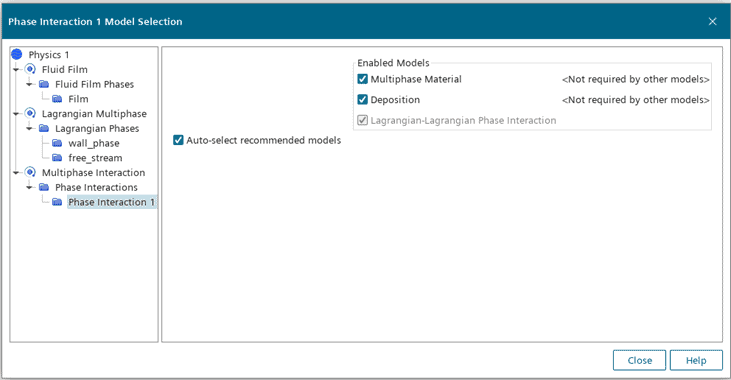
- Multiphase interaction – We create a multiphase interaction between our two Lagrangian phases and make sure that the “Deposition” model is activated. That will allow us to go from free-stream to wall-bound. If you don’t include the deposition model, you need to specify a specified injector for your wall-bound phase.

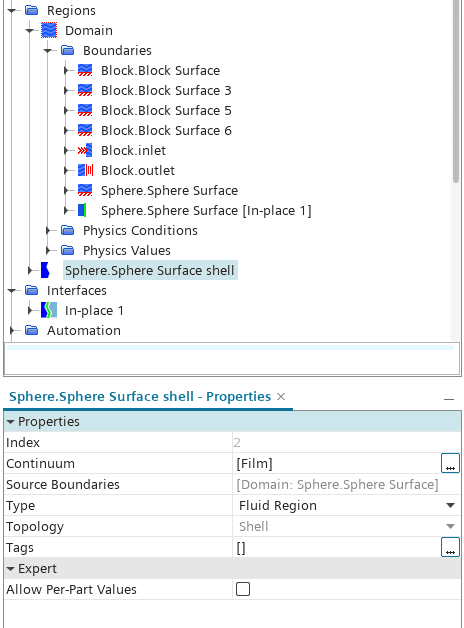
- Shell region creation – We create the shell region on the surface where we want our wall-bound phase, and then select the “film”-continuum.

- Injectors – Aside from the manual creation of the free-stream phase injector, one injector is created automatically from the model selection for the wall-bound phase. We get a “Parcel transfer injector” where we choose our wall-bound phase as the Lagrangian phase and the free-stream phase as input. This will provide a transition to the wall-bound phase.

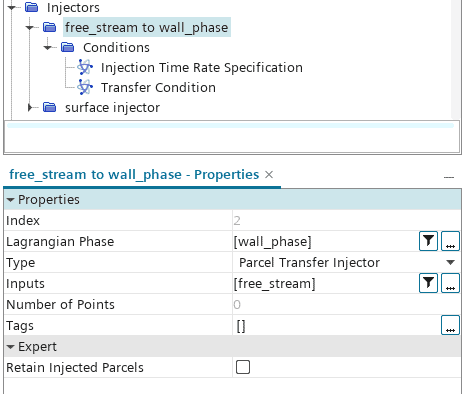
Compared to other Parcel transfer injectors, you do not need to specify the transfer condition for the transition between the free-stream phase and the wall-bound-phase. This is pre-populated to be “Model driven”. 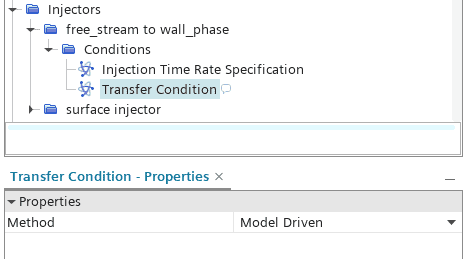
As we are located on the shell region, we should, just as we do when we have a fluid film, set the edges of our fluid film to an outlet. Otherwise, there will be an accumulation of Lagrangian parcels on the wall-edge.
The example
This is a simple example to show the wall-bound phase in action. The domain is a cylinder where the free-stream phase is injected from above. The wall-bound phase can then deposit on a partial sphere. The spherical object has a slight rotation, which will help us to see the wall bound phase on its surface.

THE NTC-collision model
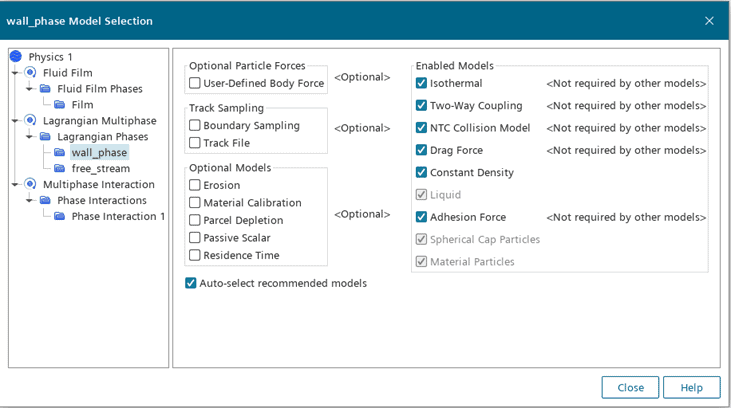
As can be seen above, we have the NTC-collision model active for the wall-bound phase (model selection for the wall-bound phase). This allows for wall-bound droplets to collide and coalesce into larger droplets on the surface.
For NTC, we usually use a collision outcome map to decide the effect of collision. For the free stream phase there are a couple of models; O´Rourke and Ashgritz and a Composite map (shown below). In the composite map, different models can be used to calculate the result for different outcomes in the collision outcome map.

The two important parameters in the collision outcome maps are the Impact parameter, basically telling us how close two particles are to each other, and the collision Weber number, providing a relation between the size, relative velocity and surface tension of the droplets. These together with droplets size ratio, decide the outcome of the collision. In our situation, the only outcome is coalescence.
The animation
This is what the result can look like when using the wall-bound phase. Note that while the free-stream phase is hidden after a while, it is still there to populate the wall-bound phase. It is simply removed to more clearly look at the phase sliding down the surface. If you look really close you can see that larger particles that are sliding downwards absorb smaller particles that by themselves do not overcome the surface adhesion force.
I hope that this has been useful to you and can perhaps give you some ideas on how to use the wall-bound Lagrangian droplets. As usual, reach out to support@volupe.com with any questions.
Author

Robin Victor
support@volupe.com
