
It is time again to look at the latest version of Simcenter STAR-CCM+ 2606 and what it brings for the different multiphase simulations. The latest version of Simcenter STAR-CCM+ was released in the beginning of July, meaning it is high time to learn what we can do with it.
Phase change using Phasic Porous media with EMP
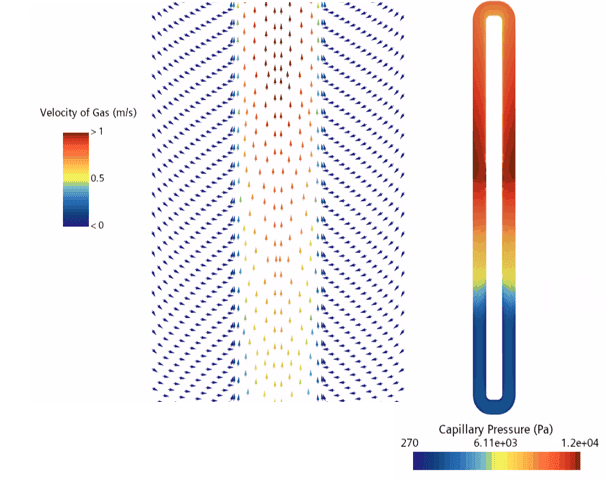
During my seven years working as an application specialist, I have been asked several times if it is possible in Simcenter STAR-CCM+ to simulate heat pipes. The answer to that question has always been that the size scale of that problem lies outside the scope of what is practically possible to simulate. While this is still true for a fully resolved heat pipe, the introduction of the Capillary Pressure and Relative Permeability modelling from a few versions ago, now allows for this. In this version, these models have been made compatible with phase change, including evaporation, condensation and bulk boiling. This gives us exactly what we need to simulate a heat pipe.
Build in Stokes-Cunningham Drag model for LMP
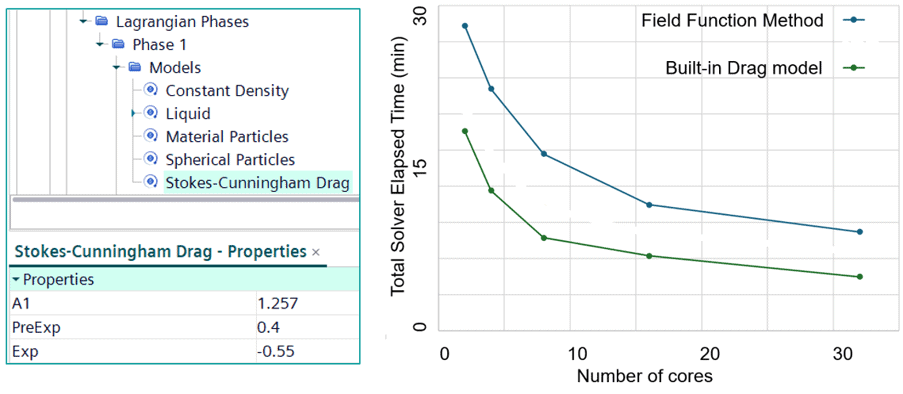
Simcenter STAR-CCM+ 2606 now includes a built-in Stokes–Cunningham Drag model to accurately simulate drag on submicron particles in low-Reynolds-number gaseous flows. By natively applying the Cunningham slip correction factor, the solver bridges the gap between continuum and free molecular flow. This update eliminates the need for complex user-defined field functions, streamlining workflows for critical industries like semiconductor manufacturing and microfluidics. Additionally, optimized native algorithms deliver a 20%+ speed lookup for steady-state Lagrangian simulations over previous custom methods. The plot below compares the solver time between the manual implementation and the new built in model and there is a clear speed up across all tested CPU core counts.
Conjugate heat transfer with SPH
This version around, a lot of effort has been given to the SPH-solver with several new features.
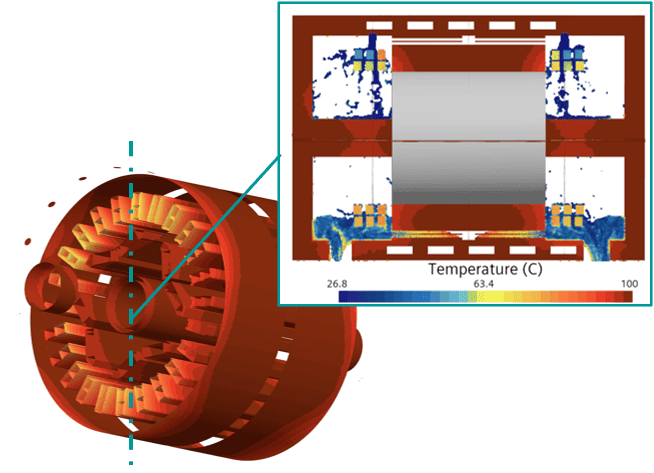
Building on the fluid energy equation introduced for SPH in version 2602, Simcenter STAR-CCM+ 2606 now enables fully coupled Conjugate Heat Transfer (CHT) simulations within the SPH solver. By coupling SPH directly with the core energy solver, users can simultaneously resolve both fluid and solid temperature fields.
This integration unlocks advanced thermal physics and boundary conditions, allowing for complete modelling of fluid temperature evolution, solid temperature propagation, and wall heat transfer. To maximize efficiency, the workflow supports two time-stepping strategies within a single, unified environment:
- Direct Coupling: Synchronous updates for highly transient physics.
- Staggered Approach: Mixed timescales to optimize performance when fluid and thermal speeds diverge.
The implementation supports coupling with both Finite Volume (FV) and Finite Element (FE) energy solvers. For teams utilizing hardware acceleration, GPU execution is fully supported when coupling with the FV energy solver, while FE coupling remains CPU-based.
Temperature dependent Dynamic viscosity for SPH
It is now also possible to have the viscosity of the fluid defined as a function of temperature. This improves the accuracy in temperature driven applications and is of course very relevant for the CHT-capabilities. You can define the temperature dependence using a table, field function or a polynomial. The video shows the difference in fluid behaviour when the fluid hits a hot glass.
Aerodynamic forcing for SPH
Simcenter STAR-CCM+ 2606 introduces the ability to map a flow field from the standard Flow Solver directly into an SPH simulation as a background flow field. This addition drastically improves SPH simulation fidelity by enabling realistic interactions with turbulent airflow or wind-driven sprays.
For example, this allows users to simulate SPH water droplets being driven around a vehicle body by an aerodynamic airflow field previously computed in the Finite Volume (FV) solver. Phase interactions between the SPH particles and the background flow field are accurately handled via the integrated Liu Drag Force model. The workflow supports both fully transient coupling for dynamic conditions and steady-state snapshots to minimize computational overhead.
Inlet with volume fraction definition for SPH
The final update for SPH enables more realistic boundary conditions by allowing a volume fraction to be specified on the inlet. This enables more complex inlet conditions like the rainfall seen in the video to be easily modelled. In the case of rainfall, the droplet size and frequency can be specified using field functions.
This summarizes the multiphase updates for the latest version. Hopefully this can give you some ideas in your work. As usual, reach out to support@volupe.com with any questions you might have.
Author

Robin Victor
support@volupe.com
