
Simcenter PhysicsAI
Put your simulation history to work on the next design
Train predictive models from existing simulation results with Simcenter PhysicsAI, formerly Altair PhysicsAI. Screen design variants, review predicted performance and focus detailed solver analysis on the concepts that warrant further investigation.
What is Simcenter PhysicsAI?
Simcenter PhysicsAI uses geometric deep learning to build predictive models from simulation data. It learns relationships between geometry, input conditions and the responses contained in the training data, then estimates results for new designs.
Depending on the model and workflow, outputs can include performance indicators, response curves and spatial fields such as stress, pressure or temperature. This supports early screening and design exploration while keeping high-fidelity simulation available to validate important decisions.
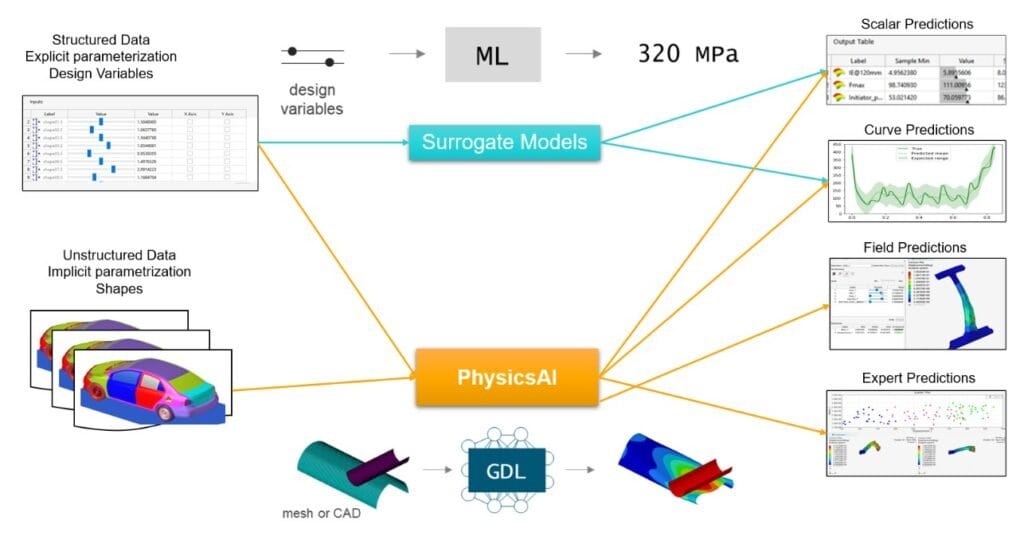
Simcenter PhysicsAI capabilities
- Reuse simulation datasets: Build a training project from suitable historical results or newly generated studies instead of starting every exploration from a blank dataset.
- Learn from geometry: Train on supported mesh or CAD representations, with relevant non-geometric inputs included where the chosen workflow supports them.
- Predict engineering responses: Estimate selected fields, performance indicators or curves using the output types supported by the model architecture.
- Check model behavior: Review validation errors and geometric similarity information to judge whether a new design is appropriately represented by the training data.
- Work inside CAE environments: Access PhysicsAI through supported integrations in Simcenter Hypermesh, Simlab and Inspire, and through the STAR-CCM+ add-on.
- Connect screening with CFD exploration: In STAR-CCM+, use the add-on workflow to train and evaluate surrogate models alongside the detailed simulation reference.
Practical PhysicsAI workflows
- Structural concept screening: Train on suitable structural simulation results, compare predicted responses for new shapes and investigate the most promising designs with the original solver.
- CFD design exploration: Reuse a STAR-CCM+ study to train a surrogate, screen geometry variants and compare selected predictions against detailed CFD results.
- A reusable simulation dataset: Curate consistent results from a product family, define the input features and output responses, and validate a model before using it on the next design study.
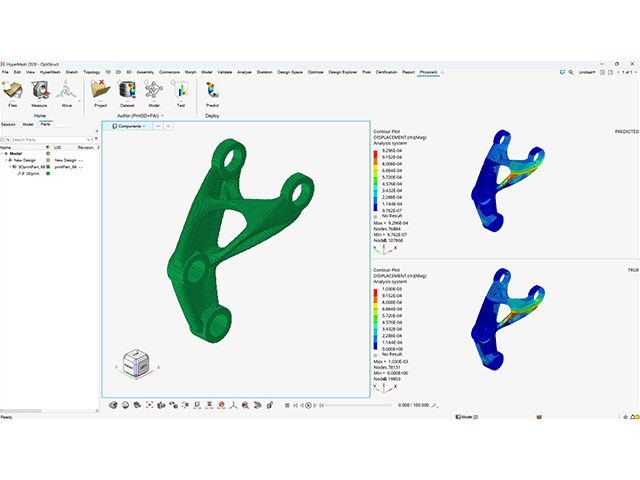
Evaluate your PhysicsAI starting point with Volupe
Tell us which solver you use, what simulation results are available and which design decisions you want to accelerate. We can discuss dataset readiness, the relevant integration, licensing and a practical validation workflow.
Frequently asked questions about Simcenter PhysicsAI
How is PhysicsAI different from a solver such as Optistruct?
Optistruct computes a response from a physical model and its analysis equations. PhysicsAI trains on existing simulation results and predicts responses for new inputs. It can support screening and exploration, while the underlying solver remains the reference for detailed analysis and validation.
What data do I need to train a model?
You need suitable simulation results that represent the geometry, conditions and responses relevant to your intended predictions. Consistent labels, materials, loads and result definitions matter. The amount of data required depends on the problem; a fixed sample count cannot guarantee a useful model.
Can PhysicsAI evaluate new geometry?
Yes. Its geometric approach can work with variations in shape and topology without requiring the same traditional design parameters for every sample. Predictions still need validation. Review similarity and error information carefully when a new design differs substantially from the training examples.
Is PhysicsAI included in my existing software license?
Access depends on the host application, release and commercial configuration. The STAR-CCM+ integration is offered as an add-on. Contact Volupe to review your environment, the intended workflow and the current licensing options before assuming access or a particular price.
