Material properties for FEA
Young’s modulus, Poisson’s ratio, density and strength by grade, in your solver’s units.
Calculator
When you set up a material in an FE model you need Young’s modulus, Poisson’s ratio and the shear modulus, the density in the model’s own units and, for a thermal run, the thermal expansion, conductivity and specific heat. The calculator above gives them, with the yield and tensile strength, for one grade, product form and thickness of common steels, stainless steels, aluminium alloys, titanium and copper. It shows the basis of each value, because a specified minimum is not a typical value, and writes the material card in the unit system your solver uses. The tables further down list every grade and temper.
Young’s modulus (modulus of elasticity)
Structural steel has a Young’s modulus of E = 210 GPa, or 210,000 MPa, the design value of EN 1993-1-1, clause 3.2.6, as SCI gives it [1, 2].
Young’s modulus, also called the modulus of elasticity, is the constant ratio of stress to strain in the straight first part of the stress–strain curve [3]:
E = σ / ε (1)
Strain is a change of length per unit length and has no unit [4], which leaves E with the unit of stress, the pascal, in practice GPa or MPa, where 1 MPa is 1 N/mm² [5]. See where E sits on the stress–strain curve.
The modulus of carbon steel does not change with the grade [1], although the minimum yield strength of S460N is almost twice that of S235. From one aluminium alloy to another it changes a little [4], and the modulus of copper depends on its temper, with 110 GPa annealed and 130 GPa cold worked [6].
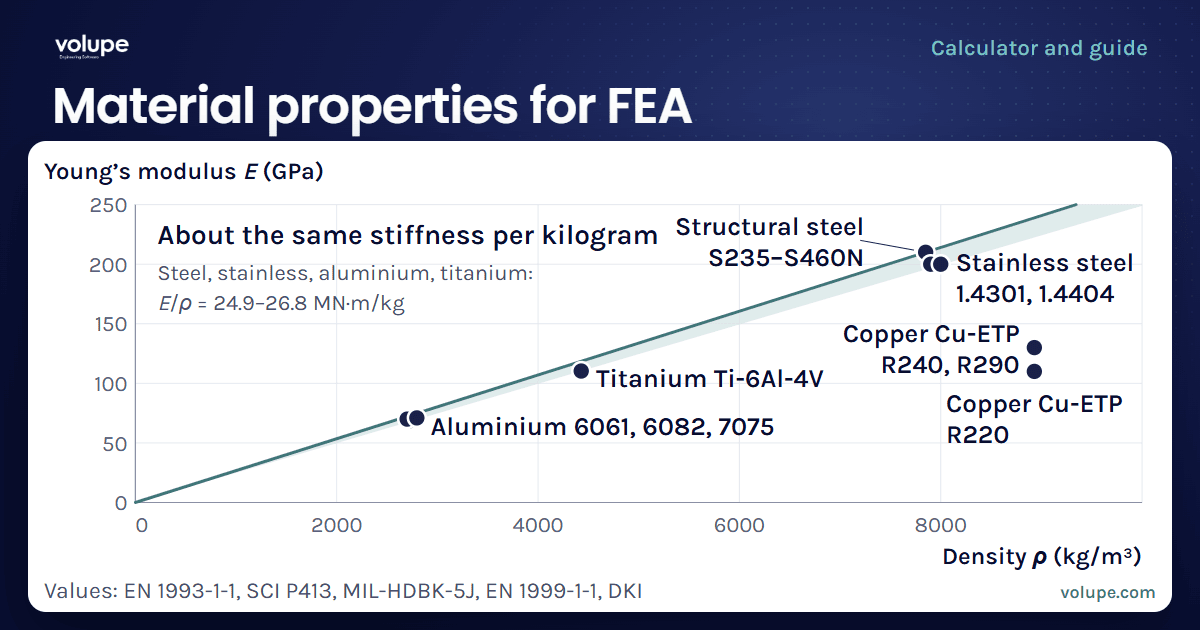
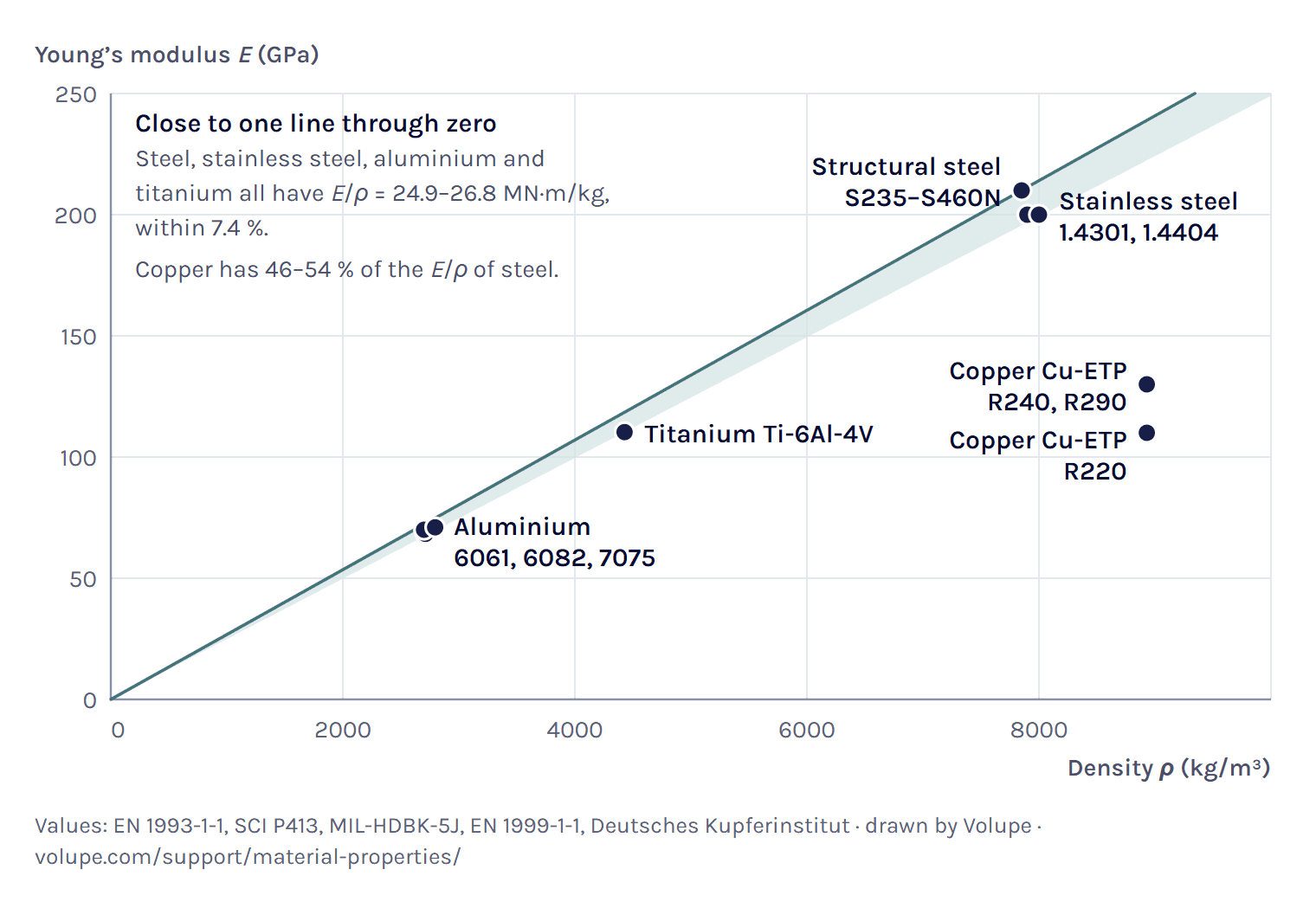
Structural steel has a specific stiffness E/ρ of 26.8 MN·m/kg, and the aluminium alloys at the EN 1999-1-1 values have 25.9 MN·m/kg. For parts of identical shape, ν and supports, the eigenfrequencies scale with the square root of E/ρ. Swap a steel bracket for an aluminium one and its natural frequencies drop by only 1.6 %, while it has a third of the stiffness and about a third of the mass.
Show Young’s modulus in the calculator ↑
Young’s modulus of steel
Carbon steels S235 to S460 all have E = 210 GPa (EN 1993-1-1) [1], and austenitic stainless steels such as 1.4301 (304) and 1.4404 (316L) have 200 GPa, the value EN 1993-1-4 and EN 10088-1 give for structural design [7].
210 GPa is 210,000 N/mm², 21,000 kN/cm² or 3.05 × 10⁷ psi, and MIT’s course data use it for mild steel too [8]. It is a design value, the number a code tells you to use, and a test need not reproduce it. In BAM’s tensile test of an S355 sheet, the record our stress–strain calculator uses, the modulus came out at 199 GPa [9]. The modulus also falls as the steel gets hot, see material properties at elevated temperature below.
Young’s modulus of aluminium
Aluminium alloys have E = 70 GPa as the design value of EN 1999-1-1, clause 3.2.5, for all the alloys it covers [10, 11], a third of steel’s 210 GPa.
MIL-HDBK-5J lists 68.3 GPa (9.9 × 10³ ksi) for 6061 and 71 GPa (10.3 × 10³ ksi) for 7075 as typical values [4]. If you choose 6061-T6 or 7075-T6, the calculator uses the MIL-HDBK-5J set, because their strengths come from that handbook too, and for 6061 it shows EN 1999-1-1’s 70 GPa and ν = 0.3 as the code alternative. For 6082-T6 it uses the EN 1999-1-1 values.
Poisson’s ratio
For steel, use a Poisson’s ratio of ν = 0.3, which EN 1993-1-1 gives in the same clause as E [1, 2]. SCI takes 0.3 for austenitic stainless steel [7]. For aluminium alloys you will find 0.3 in EN 1999-1-1 [10] and 0.33 as the typical value in MIL-HDBK-5J [4].
Pull a bar and it gets thinner as it gets longer. Poisson’s ratio is that lateral strain divided by the axial strain, with the sign changed so that ν comes out positive [4]:
ν = −εlat / εaxial (2)
In the elastic range the ratio is about constant. Past the proportional limit it changes with strain, and MIL-HDBK-5J then calls it the lateral contraction ratio [4]. For an isotropic material ν lies between −1 and 0.5, and for metals it is typically near one third [12]. The NU field of a Simcenter Nastran MAT1 card takes values above −1.0 and up to 0.5 [13].
If ν gets close to 0.5, the element formulation starts to matter. Simcenter STAR-CCM+ treats solids as compressible by default, which its documentation says suits linear elastic materials with ν up to 0.45. Above that, it tells you to switch on one of its nearly incompressible solid models [14]. In the linear solutions of Simcenter Nastran, the default integration of CHEXA and CPENTA elements without midside nodes is the recommended one because it keeps shear locking and Poisson’s ratio locking small [13]. The metals on this page, at 0.3 to 0.35, are far from that limit.
Shear modulus from E and ν
For an isotropic material only two of E, G and ν are independent, and the shear modulus G follows from the other two [13, 1]:
G = E / 2(1 + ν) (3)
Structural steel with E = 210 GPa and ν = 0.3 has G = 80.8 GPa, often taken as 81 GPa [1]. Aluminium with 70 GPa and 0.3 has 26.9 GPa, against the 27 GPa EN 1999-1-1 gives [10]. The calculator computes G from E and ν, and the three values it shows agree exactly.
MIL-HDBK-5J gives G as a separate value, and its three numbers for 6061, E = 9.9 × 10³ ksi, G = 3.8 × 10³ ksi and ν = 0.33, are 2.1 % away from (3) [4]. On a material card that matters, which is why the card section below gives E and ν and leaves G blank.
Density of steel
The density of structural steel is ρ = 7850 kg/m³, which is 7.85 g/cm³, 7.85 kg/dm³ or 7.85 × 10⁻⁹ t/mm³ [15, 7]. It is the value of the Eurocode fire design of steel (EN 1993-1-2, in the JRC worked examples) and of SCI’s design manual.
The calculator uses 7850 kg/m³ for every carbon steel, S235 to S460N. MIT’s course data give 7.8 g/cm³ for mild steel, which agrees to two figures [8]. Austenitic stainless steel is a little heavier, 7900 kg/m³ for 1.4301 (304) and 8000 kg/m³ for 1.4404 (316L) [7], and aluminium alloys have 2700 kg/m³ in EN 1999-1-1 [10]. Ti-6Al-4V has 4429 kg/m³ [4] and Cu-ETP 8930 kg/m³ [6].
A steel plate 1 m² and 10 mm thick has a mass of 7850 kg/m³ × 0.01 m³ = 78.5 kg. If your model is in millimetres and tonnes, the plate should come out at 0.0785 t, a quick check of the density on the material card. In US units steel is 0.2836 lb/in³ or 490.1 lb/ft³.
Yield and tensile strength by grade
Up to 16 mm thick, the minimum yield strength of structural steel runs from 235 MPa for S235 to 460 MPa for S460N [16, 17]. Stainless 1.4301 and 1.4404 have 190 to 240 MPa by product form [7], 6061-T6 and 6082-T6 have 248.2 to 260 MPa [4, 18], 7075-T6 has 475.7 to 489.5 MPa and annealed Ti-6Al-4V has 813.6 to 868.7 MPa [4]. These are minimum, nominal or A-basis values, not typical ones. In BAM’s tensile test the S355 sheet had an upper yield strength ReH of 378.8 MPa, against the minimum of 355 MPa, and a tensile strength of 503.7 MPa [9]. The steel standard gives the tensile strength as a range, and S355 has 470 to 630 MPa from 3 to 100 mm [19].
Carbon steel has an upper yield strength ReH, while stainless steel and aluminium have a 0.2 % proof strength Rp0.2. The MIL-HDBK-5J tables give Fty and Ftu as A-basis allowables, values that at least 99 % of the material should exceed with 95 % confidence [4], and this page gives those for the longitudinal (L) direction. In the long-transverse direction 6061-T6 sheet has Fty = 35 ksi (241.3 MPa) instead of 36 ksi [4]. For the yield strength of a test curve and the 0.2 % offset, see the stress–strain curve calculator.
The product form matters even within one grade. If you order 1.4301 as cold-rolled strip up to 8 mm, you can count on a nominal Rp0.2 of 230 MPa, and as hot-rolled plate up to 75 mm on 210 MPa, the EN 1993-1-4 values that equal the EN 10088 minima [7]. 6082-T6 extrusions have 250 MPa up to 5 mm wall and 260 MPa above, to 25 mm for open and 15 mm for hollow profiles, the EN 755-2 minima in Hydro’s datasheet [18]. EN 13599 specifies the tensile strength of Cu-ETP, at least 240 MPa for R240, and gives an Rp0.2 of at least 180 MPa for information only. These limits come from the Deutsches Kupferinstitut datasheet of 2005 [6], and Kemper’s 2024 datasheet has the same Rp0.2 limits for R220, R240 and R290 [20].
Yield strength of steel
For S355 to EN 10025-2 the minimum yield strength is 355 MPa up to 16 mm thick and falls to 295 MPa from 100 to 150 mm [1, 19]. In between it is 345 MPa to 40 mm, 335 MPa to 63 mm, 325 MPa to 80 mm and 315 MPa to 100 mm, the values of SCI and the British Steel declaration. If you size an S355 plate 40 mm thick, you can count on 345 MPa. The yield strength of hot-rolled steel falls with thickness, and the grade number is the value up to 16 mm [1].
Up to 16 mm, S235 has 235 MPa and S275 has 275 MPa, and from 100 to 150 mm they have 195 and 225 MPa [16, 21]. S460 here is S460N to EN 10025-3:2019, normalised plate, with 460 MPa up to 16 mm, 400 MPa from 80 to 100 mm, 380 MPa from 100 to 150 mm and 370 MPa from 150 to 250 mm [17].
A plate 16 mm thick is still in the first band and one of 16.01 mm is in the next, because EN 10025 writes the bands as up to 16 mm, over 16 up to 40 mm and so on. The calculator takes S235 to S355 from 3 mm, where our sources start giving Rm, to 150 mm. For S460N it runs from the thinnest plate to 250 mm, the range of its declaration [17].
Coefficient of thermal expansion
Structural steel has a coefficient of thermal expansion of α = 12 × 10⁻⁶/K, or 12 µm per metre and kelvin, in the ambient temperature range [1]. The coefficient is the thermal strain per kelvin of temperature change [13]:
ε = αΔT (4)
Austenitic stainless steel has 16 × 10⁻⁶/K between 20 and 100 °C [7], and aluminium alloys have 23 × 10⁻⁶/K below 100 °C (EN 1999-1-1) [10]. Warm a steel bar 1 m long from 20 to 100 °C and it grows by 0.96 mm, an aluminium one by 1.84 mm. Hold the steel bar between two rigid walls so that its length cannot change, and it takes a compressive stress of EαΔT = 201.6 MPa, 57 % of the yield strength of S355 up to 16 mm. The aluminium bar would expand almost twice as much, but with a third of the stiffness it takes 128.8 MPa.
SCI gives the coefficients of steel and stainless steel as mean values between 20 and 100 °C [7]. The Deutsches Kupferinstitut gives Cu-ETP 16.8 × 10⁻⁶/K between 20 and 100 °C and 17.7 × 10⁻⁶/K between 20 and 300 °C [6]. With TREF = 20 °C on the card, a mean value from 20 °C gives the right thermal strain at one load temperature in a linear run [13] (see the card section).
Thermal conductivity and specific heat
If you run a thermal analysis, or a thermal and structural one, you also need the thermal conductivity k and the specific heat cp. At room temperature SCI gives S355 k = 53 W/(m·K) and cp = 440 J/(kg·K), which the calculator uses for all four carbon steels, and austenitic stainless steel 15 W/(m·K) and 500 J/(kg·K) [7]. Stainless steel conducts heat less than a third as well as carbon steel. 6082-T6 has 172 W/(m·K) and 897 J/(kg·K) as typical values from Hydro [18], and Cu-ETP 394 W/(m·K) and 386 J/(kg·K) [6].
The calculator has no α, k or cp for 7075-T6 and Ti-6Al-4V, and no k or cp for 6061. There it shows a dash marked “not included”. MIL-HDBK-5J gives these properties only as curves [4], and this version does not read values off them.
In mm-t-s, k keeps its number, since 1 W/(m·K) is 1 mW/(mm·K). cp must be multiplied by 10⁶, and steel’s 440 J/(kg·K) becomes 4.4 × 10⁸ mm²/(s²·K), the unit Siemens gives as mJ/(tonne·°C) in its mJ-mm-s-°C set [13].
Material properties at elevated temperature
For fire design, EN 1993-1-2 Table 3.1 gives carbon steel at 400 °C the reduction factor kE,θ = 0.70, and E = 147 GPa [15]. At 600 °C kE,θ = 0.31 and E = 65.1 GPa, while up to 100 °C the modulus is unchanged [15]. These are values for a structure heated in a fire, and the calculator labels every value it takes from a temperature table “fire design” for that reason.
In fire design the yield strength of carbon steel is the effective yield strength, the stress at 2 % total strain. It keeps its full value, ky,θ = 1.00, up to 400 °C and falls to ky,θ = 0.47 at 600 °C, which is about 167 MPa for S355 up to 16 mm [15].
Austenitic stainless steel holds its stiffness better in a fire. For 1.4301 and 1.4404, SCI P413 Table 8.1 gives the fire-design factor kE,θ = 0.76 at 600 °C, and E is still 152 GPa, more than twice the 65.1 GPa of carbon steel at that temperature [7]. SCI gives these grouped factors as the ones expected in the next revision of EN 1993-1-2.
Between the tabulated temperatures the calculator draws a straight line. The note to the carbon steel table allows it [15], and at 550 °C you get kE,θ = 0.455 and ky,θ = 0.625. For stainless steel the straight line is our own choice, since SCI states no rule for its table. The calculator scales ReH by ky,θ for carbon steel, and Rp0.2 by kp0.2,θ and Rm by ku,θ for stainless steel, and shows the factor at your temperature with its table number.
From 15 to 25 °C, a band we chose as room temperature, the calculator shows the 20 °C values unchanged, and below 15 °C it shows none. Above the band you get E and the yield strength, for stainless steel also Rm, for carbon steel the density, which the JRC report uses at every temperature [15], and α up to 100 °C [1, 7]. For carbon steel, ν and the tensile strength have no temperature source in our references, and for stainless steel ν and the density have none.
Temperature data in this tool cover carbon steel (EN 1993-1-2) and stainless steel (SCI P413). Other materials have 20 °C values, and α as the 20 to 100 °C mean for Cu-ETP or the value below 100 °C for 6061-T6 and 6082-T6 (EN 1999-1-1), shown on the chart as a hollow point. Some of the rest has a source: the JRC figures 2.4.7 and 2.4.10 [15] and SCI P413 section 8.4 [7] give k, cp and α of steel at temperature, MIL-HDBK-5J has curves for 6061, 7075 and Ti-6Al-4V [4], and the Deutsches Kupferinstitut gives E of cold-worked Cu-ETP up to 300 °C [6]. We have not read values off them for this version, so the calculator shows a dash there.
Note that the carbon steel factors come from the 2005 edition of EN 1993-1-2. Its 2024 edition supersedes it, with national adoption by September 2027, and its Annex C for stainless steel has completely new content [22]. We have not checked whether its tables differ from the 2005 edition or from SCI’s groups.
Consistent units in FEA
In a model in millimetres and newtons the consistent mass unit is the tonne, so stresses are in MPa and density is in t/mm³: steel is 7.85E-9, not 7850 [13, 23]. Simcenter Nastran has no units of its own and cannot tell when they are inconsistent [13].
RHO is a mass density. Mass, gravity loads and eigenfrequencies all come from it: type 7850 onto the card of an mm-t-s model and the mass and self-weight are 10¹² times too large, and every eigenfrequency 10⁶ times too low [13]. The kg/mm³ value 7.85 × 10⁻⁶, right in mm-kg-ms, gives 1000 times the mass and eigenfrequencies 31.6 times too low. A static run with no gravity or inertia load does not use RHO, which is why the error can stay in a model until its first modal or gravity run.
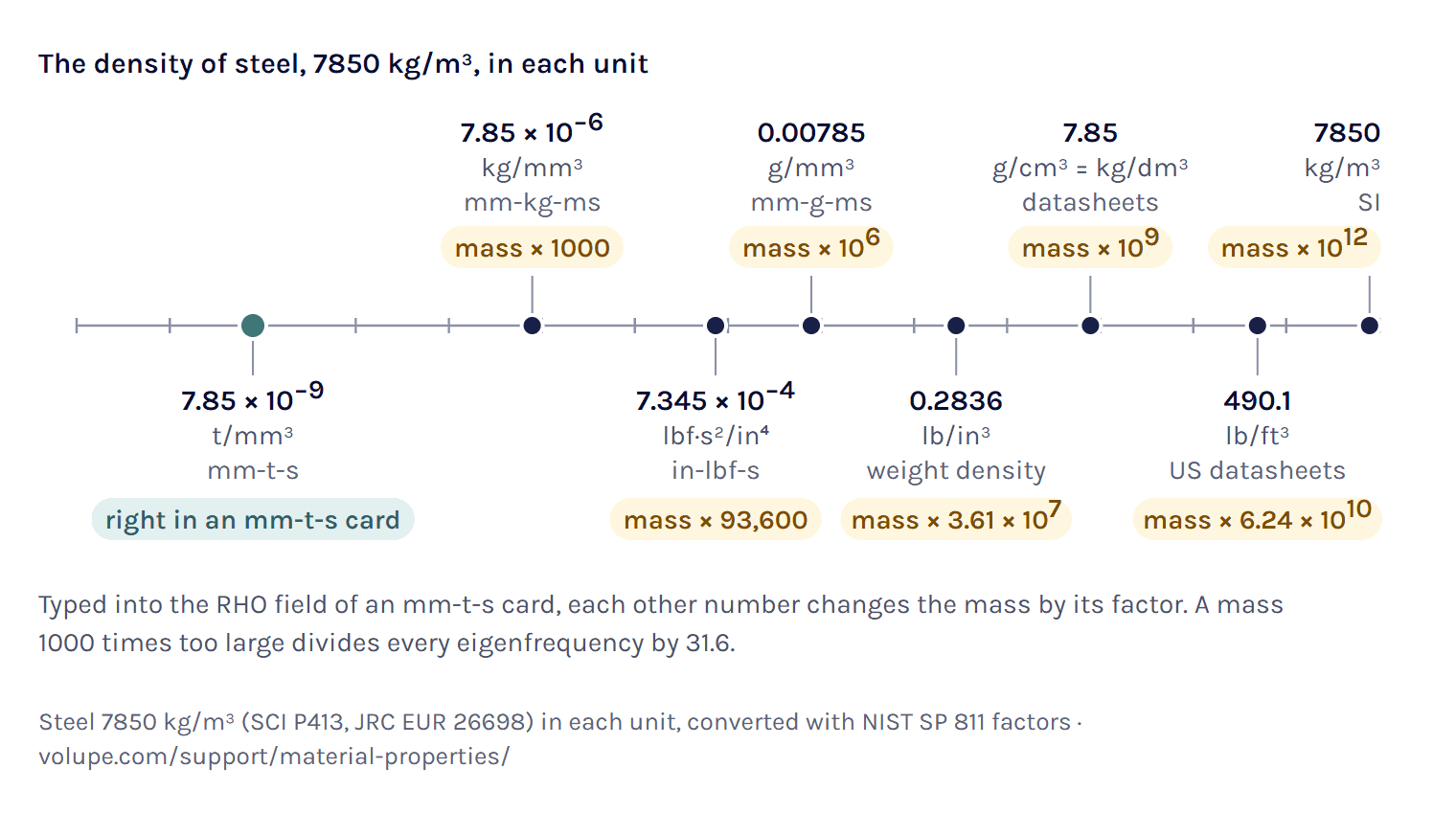
The calculator converts every value to the system you choose. It offers five, here with steel as the example:
Note that mm-t-s and mm-g-ms both use N and MPa, and E is the same number in both. Only the time unit tells them apart, and a MAT1 card does not carry it. For mm-t-s 7.85E-9 is right, while the same model with time in milliseconds needs 7.85E-3. The card check under the calculator says so whenever it applies.
In inch-pound-second units the density of steel is about 7.345 × 10⁻⁴ lbf·s²/in⁴. If you enter the weight density, 0.2836 lb/in³, instead, add PARAM,WTMASS,0.00259 so that Simcenter Nastran turns it back into mass [13]. Without it the mass is 386 times too large.
Simcenter 3D stores each value with its unit and converts every quantity to one consistent set when it writes the Nastran deck [24]. Femap does not know or check units, and the value you give for E fixes the force and length units of the model [25]. The density trap therefore appears when you type numbers into a unitless deck or into Femap. For what the solver does with these numbers, see what finite element analysis is.
Material cards for Simcenter Nastran and OptiStruct
The card the calculator opens with is S355 in mm-t-s: a Simcenter Nastran MAT1 with E = 210000., NU = 0.3, RHO = 7.85-9, A = 1.2-5 and TREF = 20., and G left blank [13]:
MAT1 has fields for E, G and ν, but an isotropic material has only two independent constants. Give E and ν and leave G blank: the solver works out G = E / 2(1 + ν). If you give all three and they do not agree, Simcenter Nastran warns but may still use all three, so different element types see different materials, and Siemens recommends that the three agree within 1 % [13].
Which constants an element uses depends on its type. Solid elements such as CHEXA, CPENTA and CTETRA use E and ν and not G, shells use G only for transverse shear, and CBAR and CBEAM elements use G for torsion and transverse shear but not ν [13].
Write nothing in a field you do not set. Given only E, SOL 401 sets ν to zero and computes G. SOLs 402 and 414 do not accept E and ν both blank, and ignore G when all three are given. In other solutions G accepts 0. as a value, so an empty G and a written 0. do not give the same card. There, ν and E (or ν and G) left blank both become zero [13].
A real number needs a decimal point, and you can drop the E and keep the sign of the exponent: 7.85-9 is 7.85 × 10⁻⁹. That keeps a value within an eight-character field. For more digits, use the large-field card, with sixteen characters per value [13]. OptiStruct accepts 210000 in the E field, but Simcenter Nastran requires 210000. with its point [13, 26]. The calculator writes an upper-case E or none, the forms the Simcenter Nastran syntax rules list.
In large field the entry name gets an asterisk, MAT1*. The first line holds MID, E, G and NU in four 16-character fields, and a second line starting with * holds RHO, A, TREF and GE [13]. The card itself carries no units. The calculator writes the unit system on a comment line above it, a line that starts with $, which both solvers read as a comment [13, 26].
TREF is the temperature at which the thermal strain is zero. In a linear run an initial temperature set for the run takes its place. In a nonlinear run the strain is counted from the initial temperature, and TREF stays the reference of a mean α [13]. For a linear run with one temperature, put the mean α from 20 °C on MAT1 with TREF = 20 °C. A nonlinear run (SOL 106, 401 and 402) reads an α table as mean values from TREF, so those mean values fit there too [13]. If you work in in-lbf-s, the calculator writes TREF in °F, 68. for 20 °C.
With a MATT1 entry and a TABLEM1, the table replaces the MAT1 value at each temperature. TABLEM1 extends the line through its two end points unless EXTRAP is set to 1, which holds the end values, and the table should cover every temperature in the model. Note that in a linear run with TEMP(LOAD) alone, the MATT1 tables are ignored and the MAT1 values are used [13]. The calculator writes one MAT1 at 20 °C, also when you choose another temperature. No source here gives ν at temperature, and a card at 400 °C would mix values from two temperatures.
Thermal conductivity and specific heat go on MAT4, which may share its material ID with the MAT1. With a MATT4 table, Simcenter Nastran multiplies the MAT4 value by the table, unlike MATT1 with TABLEM1, where the table replaces the value, and TABLEM2 always multiplies [13]. Write RHO on MAT4 too, because in Simcenter Nastran a blank RHO there means 1.0, not the density of the MAT1 [13]. OptiStruct takes the density of the structural material with the same ID [27]. The calculator always writes it.
If your deck comes from a pre-processor, check that its G field is empty, since a written 0. counts as a value [13]. In Simcenter Femap the Nastran deck is in small field unless you choose large field [25]. In Simcenter 3D you define the material in Manage Materials, and Simcenter 3D converts the values to the output units you choose when it writes the Nastran deck [24].
Simcenter OptiStruct reads the MAT1 fields with the rule of Simcenter Nastran for E, G and ν, warns when the three are more than 1 % apart and strongly recommends giving only two [28].
Under the cards, Check a MAT1 card reads a card you paste, in your browser, and tells you which unit system its E and RHO fit and whether RHO is in the wrong unit. It compares them with ranges of E and density that we set around the metals on this page, 40 to 450 GPa and 2400 to 9500 kg/m³. Paste a card whose E is below 40 GPa but fits the range in another unit, and the check warns instead of correcting. It shows E as typed and as read in that unit. If the card is for another material, or for steel at a fire temperature, keep it. Below 0.3 GPa, such an E is treated as a unit error, and numbers that fit no unit are reported as outside the ranges. It cannot see the time unit, and an mm-g-ms card typed with 7.85-9 looks exactly like a correct mm-t-s card.
Young’s modulus and density table
The table gives Young’s modulus, Poisson’s ratio, shear modulus, density, thermal expansion, thermal conductivity and specific heat at 20 °C for 12 grades and tempers, each value from the source the calculator names for it.
Yield and tensile strength table
This table gives the yield and tensile strength by grade and product form, with the basis of each value. Carbon steel is shown in its first thickness band, up to 16 mm, and the calculator gives you every band.
The tables and the calculator read one data file, and a test compares them cell by cell.
Sources and how the values were chosen
The steel strengths are the specified minimum values that producers declare under EN 10025-2 and EN 10025-3:2019, such as 355 MPa for S355 up to 16 mm [19, 16, 21, 17]. The edition of EN 10025-2 is the 2019 one that SCI and Stahlwerk Thüringen list [1, 29]. The Young’s moduli of steel, stainless steel and 6082 are Eurocode design values (EN 1993-1-1, EN 1993-1-4, EN 1999-1-1) [1, 7, 10], and the strengths of 6061, 7075 and Ti-6Al-4V are MIL-HDBK-5J A-basis allowables in the L direction [4].
The calculator prints one of these bases next to every value, and the tables give them in the basis line under each material:
A few choices are ours. S460 is S460N to EN 10025-3:2019, the S460 delivery condition our sources give for every thickness band [17]. 6061-T6 keeps the MIL-HDBK-5J set, which our stress–strain page also uses. The thermal values SCI gives for S355 are used for all four carbon steels [7]. Our reading of the designations is that Cu-ETP R220 is the annealed temper, with E = 110 GPa from the Deutsches Kupferinstitut datasheet, and R240 and R290 are cold worked, with 130 GPa [6]. Copper’s ν = 0.35 comes from a NIST review of annealed copper [12]. Ti-6Al-4V is the annealed condition only. Plastics are not in this version.
We cite the standards through the open sources that give their values, by clause or table where those sources name one, and we do not copy their tables. The editions are those SCI lists: EN 1993-1-1:2005 with A1:2014, EN 1993-1-4:2006 with A1:2015 and EN 10088-1:2014 [1]. The temperature factors are stored in the calculator to draw the curves, and the page shows only the factor at the temperature you choose. Numbers on this page without a reference, such as the unit conversions, G from E and ν and the worked examples, are our own arithmetic with the calculator’s engine.
References and changelog
References
[1] SCI, steelconstruction.info, Steel material properties: minimum yield and tensile strength to BS EN 10025-2, modulus of elasticity, shear modulus, Poisson’s ratio and thermal expansion. steelconstruction.info
[2] CEN, EN 1993-1-1:2005, Eurocode 3: Design of steel structures, Part 1-1, clause 3.2.6 Design values of material coefficients (contents, from the iTeh preview of SIST EN 1993-1-1:2005). cdn.standards.iteh.ai
[3] D. Roylance, Stress-strain curves, Department of Materials Science and Engineering, MIT, 2001 (MIT OpenCourseWare 3.11 Mechanics of Materials). ocw.mit.edu
[4] MIL-HDBK-5J, Metallic Materials and Elements for Aerospace Vehicle Structures, US Department of Defense, 2003, approved for public release: sections 1.4.1 and 1.4.3, tables 3.6.2.0(b1), 3.6.2.0(b2), 3.7.6.0(b1) and 5.4.1.0(b), figures 3.6.2.0, 3.6.2.2.4, 3.7.6.0, 3.7.6.1.4, 5.4.1.0 and 5.4.1.1.4. everyspec.com
[5] A. Thompson and B. N. Taylor, Guide for the Use of the International System of Units (SI), NIST Special Publication 811, 2008, appendix B. nvlpubs.nist.gov
[6] Deutsches Kupferinstitut, Cu-ETP, Werkstoff-Datenblätter (CW004A), 2005: physical properties, Young’s modulus and strip to EN 13599. kupferinstitut.de
[7] SCI, Design Manual for Structural Stainless Steel, 4th edition, SCI publication P413, 2017: sections 2.3.1 and 8.4, tables 2.2, 2.7, 8.1 and 8.4. cedinox.es
[8] D. Roylance, Properties of selected materials (props.csv), MIT 3.11 Mechanics of Materials course data. web.mit.edu
[9] M. Schilling, S. Glaubitz, K. Matzak, B. Rehmer and B. Skrotzki (BAM), Full dataset of several mechanical tests on an S355 steel sheet as reference data for digital representations, Zenodo, 2022, CC BY 4.0 (the tensile test on our stress–strain page). doi.org
[10] SCIA, Eurocode Training: EN 1999-1-1, section 3 Materials (EN 1999-1-1 clause 3.2.5, material constants), SCIA Engineer 2011. downloads.scia.net
[11] CEN, EN 1999-1-1:2007, Eurocode 9: Design of aluminium structures, Part 1-1, clause 3.2.5 Design values of material constants (contents, from the iTeh preview of SIST EN 1999-1-1:2007). cdn.standards.iteh.ai
[12] H. M. Ledbetter and E. R. Naimon, Elastic properties of metals and alloys. II. Copper, Journal of Physical and Chemical Reference Data 3, 897, 1974 (NIST reprint). srd.nist.gov
[13] Siemens, Simcenter Nastran documentation, releases 2412 and 2606: Quick Reference Guide (MAT1, MATT1, MAT4, MATT4, TABLEM1, TEMPERATURE, PSOLID, Bulk Data syntax rules), User’s Guide and Thermal Analysis User’s Guide.
[14] Siemens, Simcenter STAR-CCM+ documentation, release 2606: User Guide, Solid Stress (defining linear elastic materials, nearly incompressible material models).
[15] O. Vassart, B. Zhao, L. G. Cajot, F. Robert, U. Meyer and A. Frangi, Eurocodes: Background and Applications, Structural Fire Design, Worked examples, JRC report EUR 26698 EN, 2014, section 2.4, table 2.4.1 (EN 1993-1-2:2005 table 3.1, reproduction authorised with acknowledgement) and figures 2.4.7 and 2.4.10, doi:10.2788/85432. eurocodes.jrc.ec.europa.eu
[16] British Steel, Declaration of performance, Section S235JR / 1.0038 according to EN 10025-2, 2026. britishsteel.co.uk
[17] Marcegaglia Plates, Declaration of performance No 1.8901, S460N to EN 10025-3:2019, 2026. quality.marcegaglia.com
[18] Hydro, Technical datasheet, Extruded products, Alloy EN AW-6082, revision 4, 2023 (EN 755-2:2016 minimum values and typical physical properties). hydro.com
[19] British Steel, Declaration of performance, Section S355J2 / 1.0577 according to EN 10025-2, 2026. britishsteel.co.uk
[20] Gebr. Kemper, Cu-ETP datasheet, revision 03/2024. kemper-group.com
[21] British Steel, Declaration of performance, Section S275JR / 1.0044 according to EN 10025-2, 2026. britishsteel.co.uk
[22] CEN, EN 1993-1-2:2024, Eurocode 3: Design of steel structures, Part 1-2, Structural fire design, European foreword (iTeh preview of SIST EN 1993-1-2:2024). cdn.standards.iteh.ai
[23] Altair OptiStruct 2026 help (Simcenter OptiStruct), Consistent system of units. help.altair.com
[24] Siemens, Simcenter 3D documentation, release 2606: Pre/Post help, Exporting Nastran data and Manage Materials.
[25] Siemens, Simcenter Femap documentation, release 2606: User Guide and Commands Guide.
[26] Altair OptiStruct 2026 help (Simcenter OptiStruct), Bulk Data guidelines. help.altair.com
[27] Altair OptiStruct 2026 help (Simcenter OptiStruct), MAT4 bulk data entry. help.altair.com
[28] Altair OptiStruct 2026 help (Simcenter OptiStruct), MAT1 bulk data entry. help.altair.com
[29] Stahlwerk Thüringen, Structural steels according to European standard, table 3 (EN 10025-2:2019 values), 2025. stahlwerk-thueringen.de
Changelog
November 2026: first published, with the calculator, the property tables and this guide. Each value was checked against the saved text of its source, the unit conversions and derived values against our reference engine, and the Simcenter Nastran, Femap, Simcenter 3D and Simcenter STAR-CCM+ statements against the Siemens documentation. The OptiStruct statements rest on Altair’s public help.
Questions about material properties
Choose “Technical question” in the form below and describe your case.
Ask a technical question →
Is Young’s modulus the same as the modulus of elasticity?
Yes. Both names mean E, the ratio of stress to strain in the straight first part of the stress–strain curve, which is 210 GPa for structural steel.
Is Young’s modulus the same as tensile strength?
No. Young’s modulus is the stiffness, 210 GPa for structural steel, while the tensile strength is the highest engineering stress in a tensile test, at least 470 MPa for S355 from 3 to 100 mm. The modulus is 447 times larger.
What is the Young’s modulus of steel in MPa?
210,000 MPa for structural steel to EN 1993-1-1, which is 210 GPa, 210,000 N/mm² or 21,000 kN/cm², and 200,000 MPa for austenitic stainless steel to EN 1993-1-4.
What is Poisson’s ratio for steel and aluminium?
0.3 for steel (EN 1993-1-1) and 0.3 for aluminium alloys (EN 1999-1-1), while MIL-HDBK-5J lists 0.33 as the typical value for 6061 and 7075.
How do I get the shear modulus from Young’s modulus and Poisson’s ratio?
Use G = E / 2(1 + ν): 210 GPa and 0.3 give 80.8 GPa for steel, and 70 GPa and 0.3 give 26.9 GPa for aluminium.
What is the density of steel in kg/m³, g/cm³ and t/mm³?
7850 kg/m³ for structural steel, which is 7.85 g/cm³, 7.85 kg/dm³ and 7.85 × 10⁻⁹ t/mm³, or 0.2836 lb/in³ and 490.1 lb/ft³.
How do I calculate the weight of a steel plate?
Multiply length × width × thickness by the density: 1 m × 1 m × 0.01 m × 7850 kg/m³ = 78.5 kg for a plate 10 mm thick.
Why is the mass in my FE model wrong by a factor of 1000?
Because the density is in the wrong unit for the model. In mm-t-s steel is 7.85 × 10⁻⁹ t/mm³, and the kg/mm³ value 7.85 × 10⁻⁶ gives 1000 times the mass, so every eigenfrequency comes out about 31.6 times too low.