Faster Surface Remeshing in Simcenter STAR-CCM+

Johan BernanderSenior Application Specialist
With the release of version 2606, Siemens introduced the first phase of a new distributed-memory parallel Surface Remesher in Simcenter STAR-CCM+. This is the first step in a long-anticipated enhancement which can help to significantly reduce one of the most common bottlenecks in the CFD workflow: surface mesh generation.
For users working with large and complex geometries, this translates directly into shorter preprocessing times and faster turnaround from CAD model to simulation results.
Parallel scaling performance
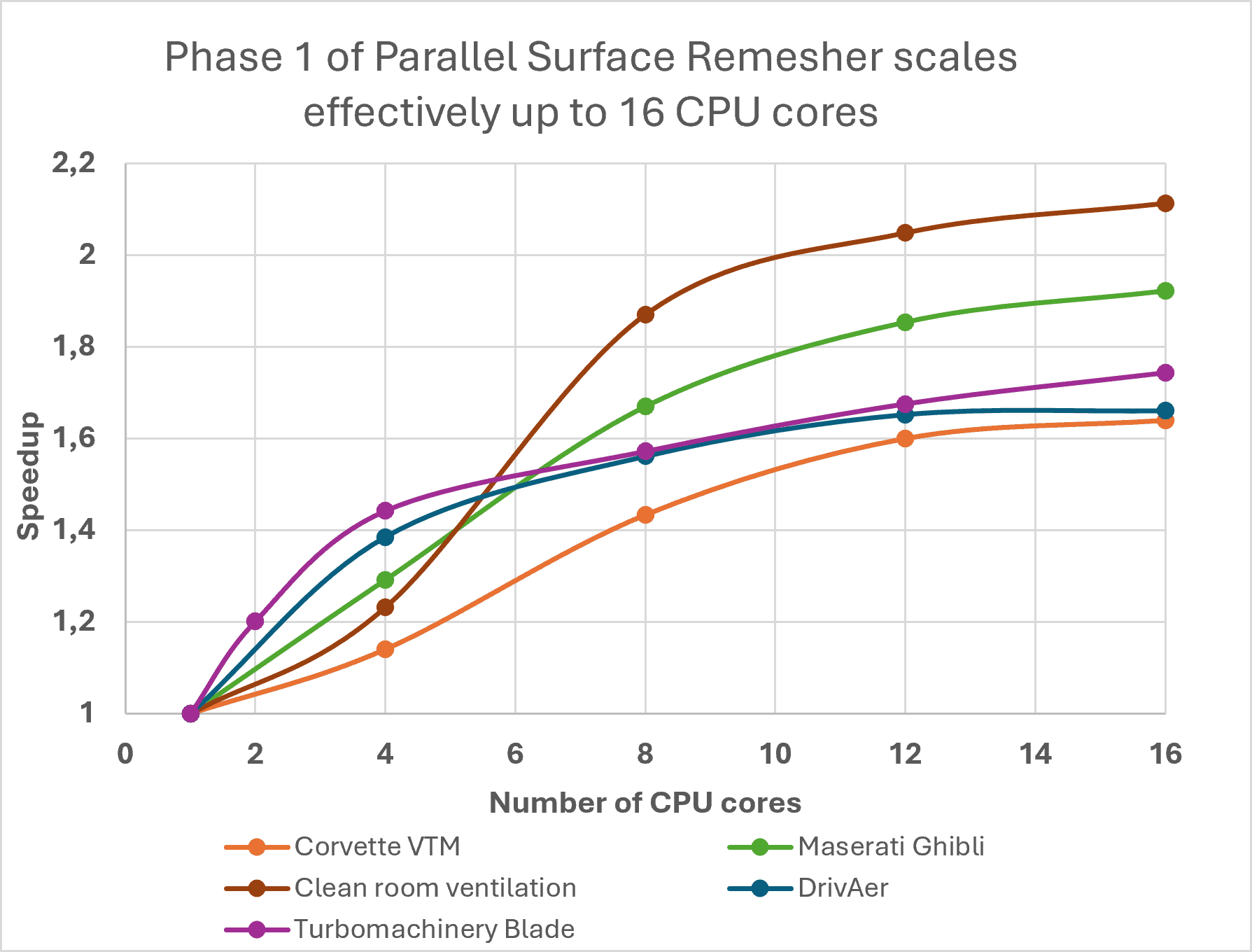
In this initial implementation phase, Siemens has parallelized the triangular meshing algorithm within the Surface Remesher. Internal benchmark testing across a variety of industrial use cases demonstrates speedups ranging from 1.6x to 2.1x when running on up to 16 CPU cores.
Some of the reported benchmark results include:
| Model | Number of faces (Million) | 1 Core | 16 Cores | Speedup |
| Corvette (Full Vehicle Thermal Simulation) | 32.4 | 47.1 min | 28.7 min | 1.6x |
| Maserati Ghibli (External Aerodynamics) | 18.2 | 45.9 min | 23.9 min | 1.9x |
| Clean Room Ventilation | 4.7 | 11.0 min | 5.2 min | 2.1x |
| DrivAer (External Aerodynamics) | 13.8 | 12.3 min | 7.4 min | 1.7x |
| Turbomachinery Blade | 24.6 | 40.4 min | 23.2 min | 1.7x |
The results demonstrate consistent performance gains across a broad range of applications, including automotive aerodynamics, HVAC, and turbomachinery. Below is a plot showing the scaling progression for a variation of core counts (up to 16 cores).
Limited scaling after 16 Cores
The internal benchmarking done by Siemens showed that core counts beyond 16 provide diminishing returns for this stage of the meshing workflow. As a result, the algorithm is set to automatically limit itself to a maximum of 16 cores, even when the simulation is launched on significantly larger HPC resources.
The core limitation has been evaluated in large-scale HPC environments running between 192 and 1024 CPU cores. Testing indicates that Surface Remesher execution times remain essentially constant regardless of the total number of cores allocated to the simulation.
This means that you can benefit from optimal performance without having to fine-tune core allocation specifically for the surface remeshing stage.
Consistent Mesh Quality Across Core Counts
One common concern with parallel meshing algorithms is consistency in mesh distribution and quality. Changes in processor count will naturally affect mesh generation to some extent, giving slight differences in element distribution.
To address this, Siemens has placed significant emphasis on consistency. Validation results show that both mesh quality and final surface cell counts remain highly stable across different numbers of CPU cores. Variations in the final mesh are generally very small and negligible for most engineering applications. Only very coarse meshes, particularly when using Aligned Meshing, may show slightly larger variations. The plot below shows a relative comparison in cell face count for parallelized surface meshing versus single core surface meshing for a variety of cases. As you can see, the differences are consistently less than 1%.
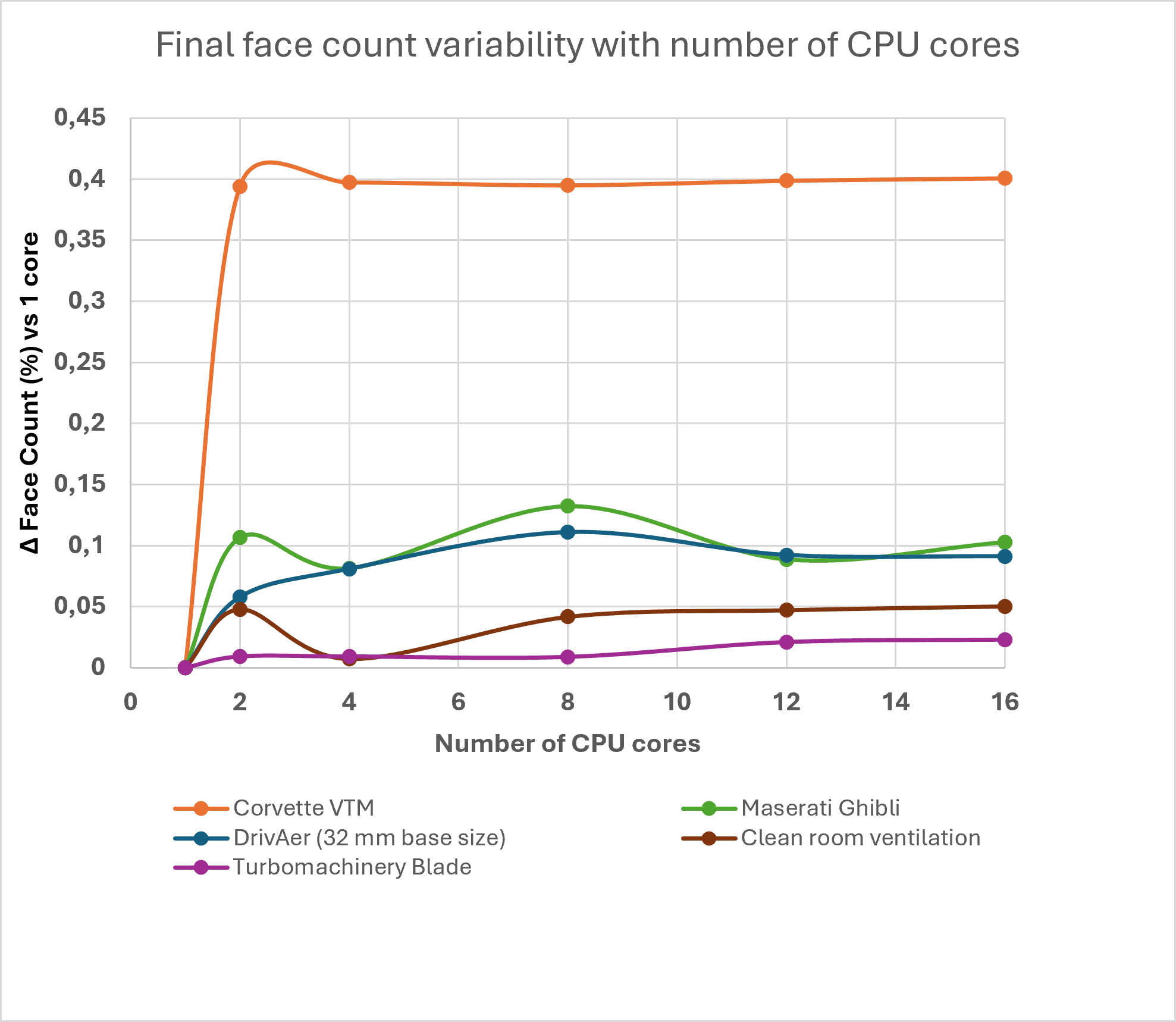
This means users can take advantage of the performance improvements without sacrificing mesh quality or confidence in their simulation setup.
Current Limitations
Described as the first phase of this functionality enhancement, this release represents the first step toward a fully parallel Surface Remesher.
In the current release:
- Only the Triangle meshing method supports distributed-memory parallelization. Enhanced Quality Triangle and Quad-based meshing methods are yet to be supported.
- Surface remeshing will revert to serial execution if a mesh control with wake refinement is present.
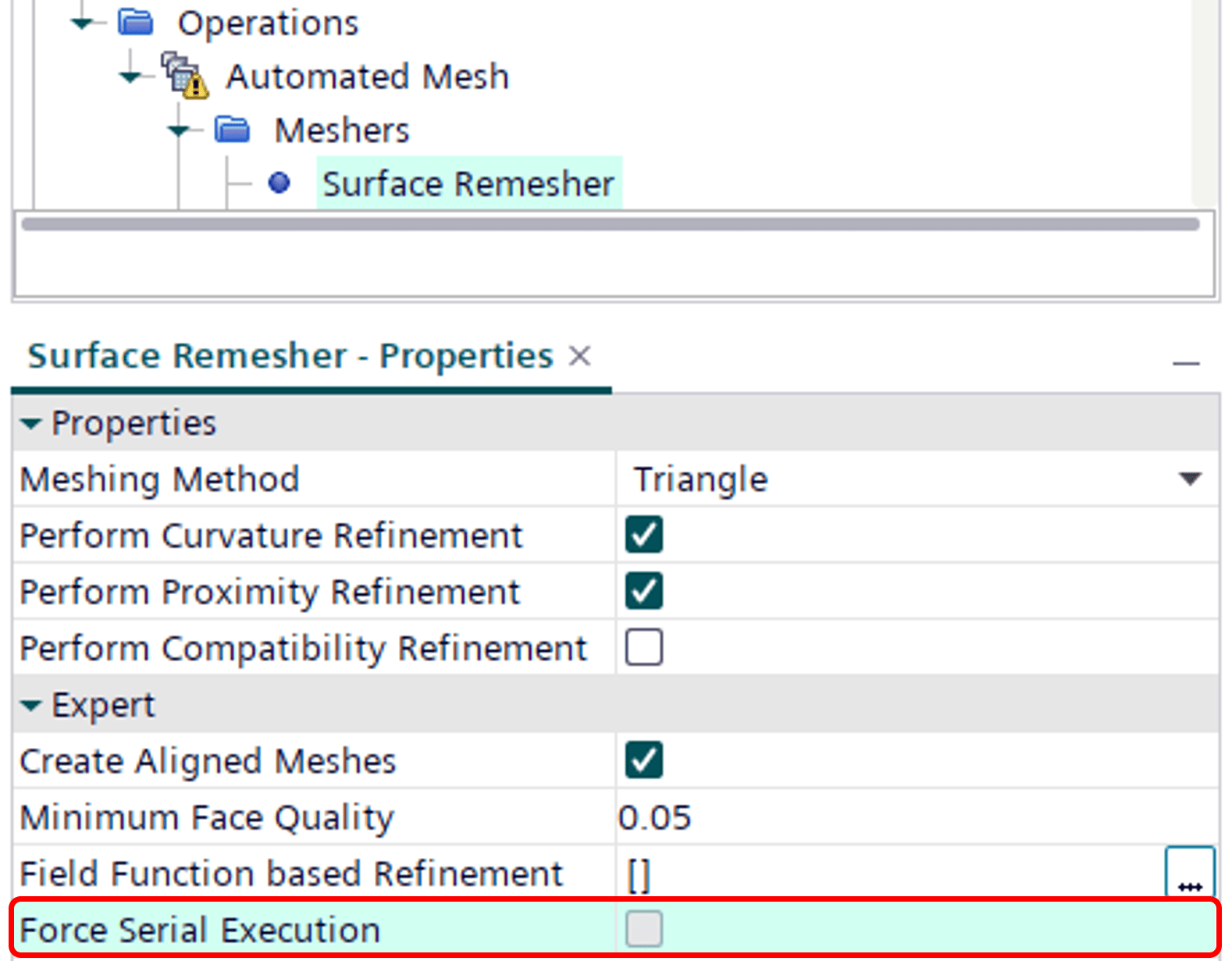
Existing simulation files opened in version 2606 will retain their previous serial setting (meaning parallelization must be manually enabled) while newly created mesh operations will have parallel execution enabled by default. Enabling parallelization for existing files is done by unchecking the “Force Serial Execution” box inside the Surface Remesher Expert properties (see below).
A promising start with more to come
The introduction of a parallel Surface Remesher marks an important milestone in Siemens’ ongoing efforts to reduce CFD preprocessing time. Although this is only the first phase of the development roadmap, it can already provide tangible productivity benefits for users working with large and demanding CFD models. Future releases are expected to expand support to additional meshing methods and further improve preprocessing performance. Make sure to stay tuned!